Last year, we toured Albania in temperatures that exceeded 40°C (104°F). We don’t have air conditioning, so here are our best tips to beat the heat, with some air conditioning recommendations thrown in.
- Don’t Let Your Camper Heat Up In The First Place
- Tips To Keep Cool Inside Your Van
- Aspects of the Build that will Keep You Cool
- How To Keep Cool Without Air Conditionng
- Air Conditioning
- Other Tips
- Help Your Fridge/Freezer
- In Conclusion
- Keeping Hot Dogs Cool
- More Tips:
Don’t Let Your Camper Heat Up In The First Place
WHAT HEATS UP THE INSIDE OF YOUR VAN?
- Hot air outside
- Direct sunlight
- YOU!
Without air conditioning, it is much harder to cool things down once they heat up, so first, here are my top tips to stay cool.
Tips To Keep Cool Inside Your Van
Shade and/or insulate your windows to stop your vehicle heating up like a greenhouse.
World Wide Walkies Wisdom
Heat from the sun shining through your windows can be the equivalent of having FOUR x 3 kilowatt heaters in your van! The last thing you want on a hot day.
While Travelling
- We insulate the windows with the foam inserts we made to keep us warm in winter.
- Foil heat deflectors or better still, thermal foil heat deflectors in the windows reflect the heat back out.
- Travelling with your blinds closed helps, although this might damage the spring return on some blinds, so use thermal foil heat deflectors instead.
- Travel in the coolest part of the day – in the morning and evening is more comfortable.
While Parked Up
Tips to Keep Cool
- Cover the OUTSIDE of your open windows to prevent the sun from streaming in through the glass. We use thermal heat deflectors, towels, blankets, sarongs, a piece of cardboard – or anything else we have to hand that will shade while allowing air flow. At night, it also gives you privacy with your windows open.
- Keep your roof lights open – hot air rises, but do be aware of security if you leave the van – could someone climb in through open windows or your roof light?
- Be aware of security – Could someone reach in and steal something through an open window? If you leave the van, could someone climb in through open windows or your roof light? For more security tips, check out my post: 25 Ways to Improve Caravan or Motorhome Security At Home & Abroad
- Put your awning on the sunny side to shade the hottest side of your van.
- If it’s hotter outside, close the windows – think about how the population of hot countries keep their homes cool with thick stone walls and closing shutters during the day. You might find it best to close and insulate/shade the windows to prevent hot air from outside making inside even hotter. At the very least, you might close and shade the windows on the sunny side of the van. Use a fan to create a nice breeze if you’re inside, then open the windows at night to cool the van down. There is a limit to how well this will work in full sun, depending on how well your van is insulated.
- Skirt – some people recommend fitting a skirt around the wheels and lower part of the van to keep the air beneath cool as the surroundings heat up. The jury’s out on this, since maintaining a flow of air might be cooler.
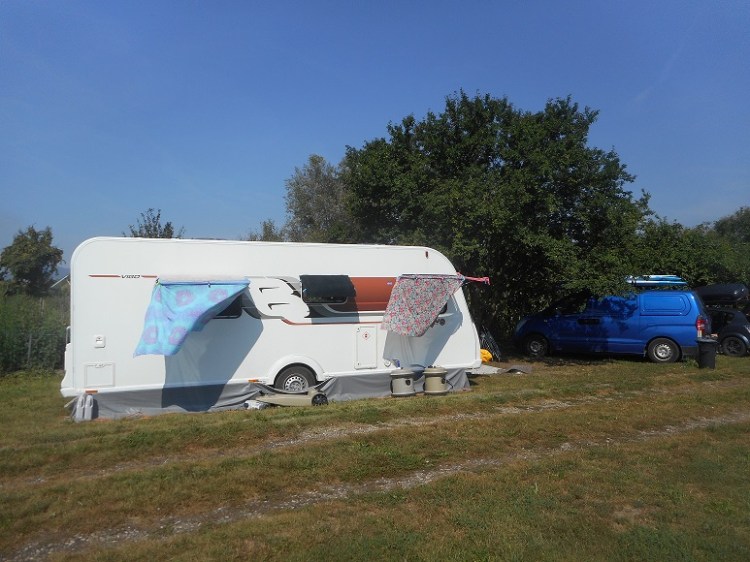
The skirt is more for Cavapoo Containment than cooling – we set up a dog run on the other side. The skirt was to stop Rosie escaping!
Choose Your Parking Spot Carefully
- Park in the shade where possible.
- If you need a solar charge, park somewhere that will at least be shady during the hottest part of the day.
- Take into account that shaded areas will change as the sun moves, so if you’re not in full shade, choose a spot which is shady during the hottest part of the day.
- Trees are cooler than artificial shade.
World Wide Walkies Wisdom!
Shade beneath trees is cooler because the trees are actively removing energy from the sunlight to photosynthesize!
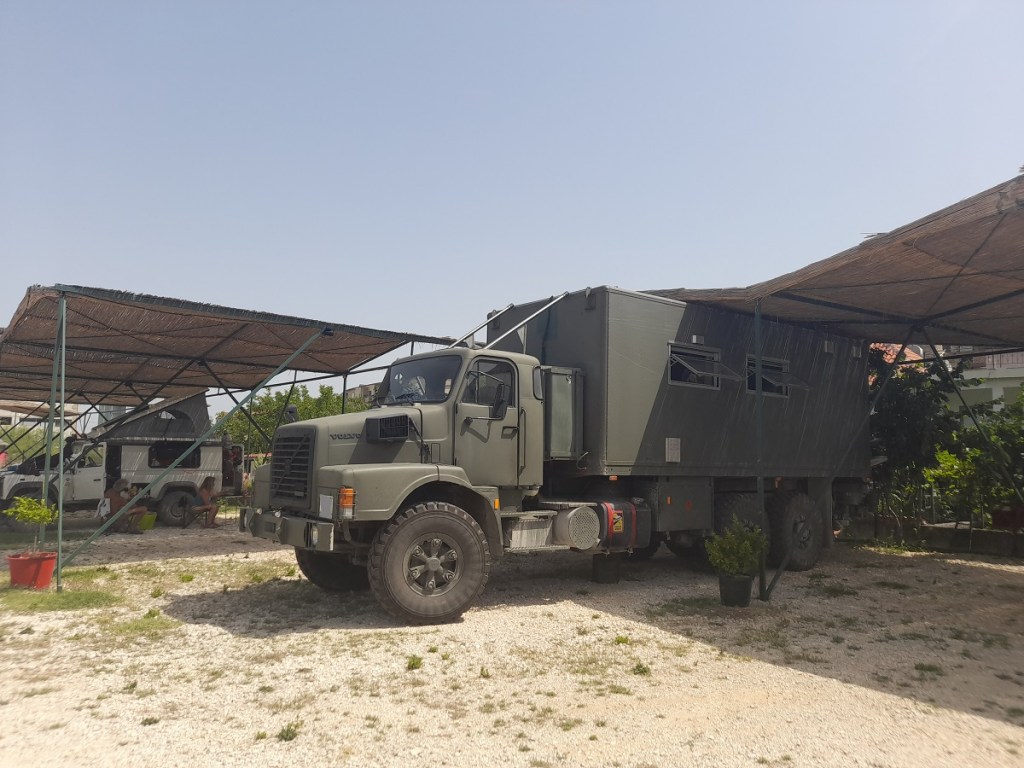
- Park facing east to west, so that the sun passes over your vehicle nose to tail. This presents the smallest surface area to heat up.
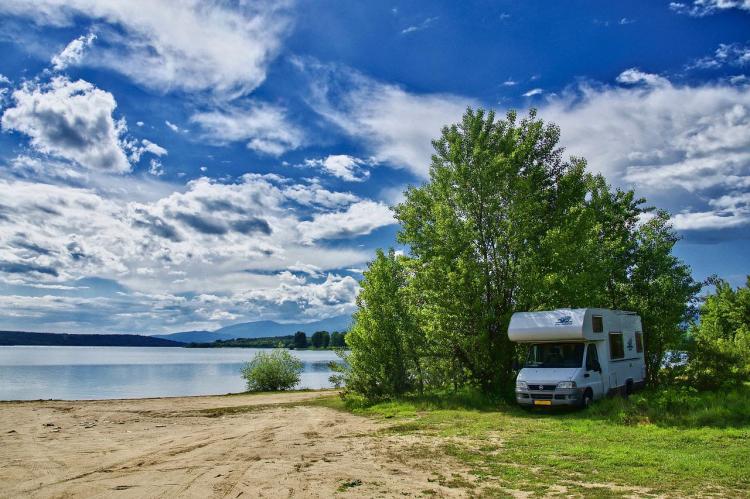
- Park near water – sea breezes don’t just happen by the sea. Land heats up more quickly than a large body of water, which causes the air above it to rise and pull in the cooler air from above the water. This creates a cooling afternoon breeze near lakes or the ocean. The down side is that there may be more biting insects or mosquitoes near water, so keep your bug screens closed, but on the up side, so long as it’s safe, at least you can have a lovely cooling dip! Websites like ACSI allow you to search for campsites near the sea or on a lakefront.
- Head for the hills – the higher you are, the cooler it is. As a general rule of thumb, if it isn’t snowing or raining, or the sun isn’t beating down on the mountainside, you will lose approximately 1°C (3.5°F) with every 100 m / 1,000 ft rise in altitude.
World Wide Walkies Wisdom!
For every 100 m / 1,000 ft rise in altitude, the air will be approximately 1°C (3.5°F) cooler.
Keep Cooking Inside to a Minimum
- A hot summer afternoon is not the time to cook a full roast dinner in the oven or pop a slow-braised casserole on the hob for three hours!
- If you want to cook, do so outside, but make sure you’re not presenting a fire hazard. In the arid summer months, many continental campsites ban campfires and BBQs for this reason. (Gas BBQs are sometimes permitted.)
- Some campsites have communal kitchen facilities you can use.
- An insulated slow cooker or air fryer will generate the least heat externally if you do need to cook hot food inside your van at the height of summer!

Aspects of the Build that will Keep You Cool
- What Colour is your Van? Darker colours absorb heat, lighter ones reflect it, which is why many RVs are white.
- Insulation – not only keeps heat in, it keeps it out! A well-insulated van will stay cooler in the heat. Don’t forget to insulate the floor. We met a Bulgarian van lifer who had built water pipes into the walls of his van to allow him to pump cold water around in the summer, and hot water in the winter!
- Lights – low energy LED bulbs emit less heat, and every little helps!
How To Keep Cool Without Air Conditionng
THERE ARE TWO WAYS TO COOL THE INSIDE OF YOUR VAN
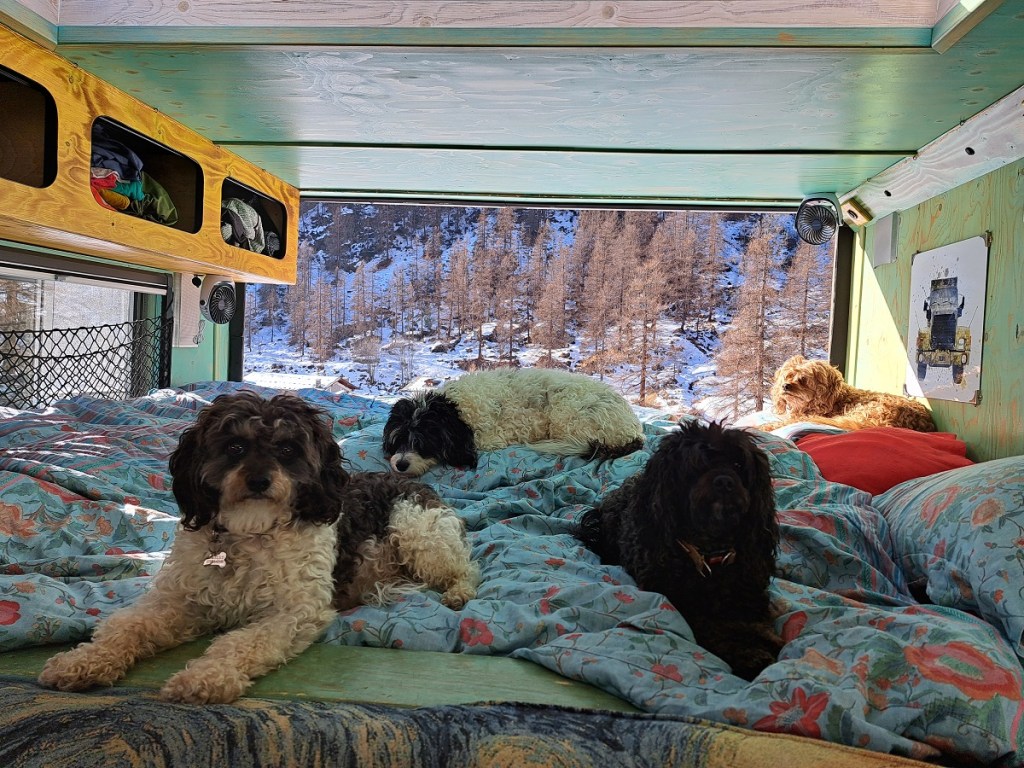
- Create airflow – Moving air around can create a sense of cooling. If you manage to draw in cool air and expel warm air, it will actively cool down your van.
- Cooling – Using some mechanism to actively cool the air.
Create Airflow Naurally
Moving air creates a cooling effect. Remember hot air rises, so:
- Open two or more windows and your roof lights – the Victorians knew a thing or two when they invented sash windows. ‘Victorian air conditioning’ involved opening the upper and lower sashes equally. The upper opening allows hot air from inside the building to leave, which drew in cooler air at the bottom. In your van, it is most effective to open the windows and roof lights, or windows opposite each other.
Create Airflow With Fans
Fans do not cool, they simply move air around, which can create a sense of cooling as it blows over your skin and evaporates sweat.
- Built In or Roof Vent Fans – Maxxair come highly recommended. One vent pulling air in and one pushing it out will be the most effective setup if you have room. Note the weight of the fan and ensure it doesn’t contribute too much to your payload.
- The BEST 12V Fan – the best and most inexpensive 12V fan we’ve found BY FAR is the Streetwize Twin Cyclone. It is more powerful than any mains-voltage fan we’ve tried, and quiet enough to sleep with. It is portable, so can be moved around your habitation area or used in the cab.
- 220V Mains Voltage Fan – the Honeywell TurboForce Power Fan is also highly rated, but requires mains voltage.
When it’s really hot, fans just move hot air around and make you feel like you’re in a fan oven, so you may want to consider some cooling.
Cooling Air Without Aircon – Evaporative Coolers
Evaporative Air Coolers, also known as Swamp Coolers chill the air slightly by blowing air over ice or water befor circulating it arond the space. The water removes heat energy from the air to evaporate. Removing energy by evaporating fluids is the same principle as refrigeration, but evaporative coolers are not true air conditioning systems (see below) which contain refrigeration liquids which remove heat much more effectively than water, and vent the heat externally.
Most Cheap & 12-volt ‘air conditioners’ are evaporative coolers, not true air conditioners, which contain refrigerants and work like your fridge. Any low cost ‘air conditioner’ is most likely an evaporative cooler.
Pros
- A less expensive alternative to air conditioning – you an even make a DIY version (see below).
- Less Bulky, Weighty, & Power Hungry than aircon – since it is just a fan and you add ice and liquid to the system.
- WWW Wisdom – you can add essential oils to keep bugs at bay. A few drops of citronella or peppermint in the water will help deter bugs.
Cons
- This system is most effective when the air is hot and dry. In high humidity, it doesn’t work so well because the air is already moist.
- Evaporative coolers add moisture to the air. This can add ‘sticky’ to the ‘hot and…’. It will also cause your fridge to frost up more quickly, and can lead to condensation and mildew in the van, particularly if you don’t dry things out before you put it into storage. We use this simple, inexpensive ThermoPro temperature and humidity monitor to keep tabs on humidity.
- Be aware of payload – with larger units.
- An evaporative cooler may be most effective to create a cool spot, eg for your dog to sit in front of, rather than cooling down the entire van.
Best & DIY Evaporative Coolers
- DIY Evaporative Cooling – freeze water in bottles, ice cube trays, or a Tupperware and place the ice in a drip tray in front of a fan. Alternatively, you can make one using a bucket and other household items. Check out this You Tube Video to make your own evaporative cooler.
- Transcool is a highly rated 12-volt evaporative cooler made in Australia.
- Viesa is an Italian-built 12V unit used by many Spanish motorhomers. Its powerful fan makes it very effective. Viesa supply the Holiday IIIs lightweight fitted cooler, and the My Viesa portable unit.
Air Conditioning
Air conditioners actively lower the temperature of the air using a refrigeration unit inside the space, and expelling heat and moisture outside.
It’s important to understand that air conditioning units don’t make heat disappear. They remove heat (and moisture) from the inside to the outside, so if you can’t vent the unit, it won’t work. That’s the catch with the first law of thermodynamics!
Pros
- Quick and efficient – air conditioning is the quickest and most efficient way to cool a space. The best air conditioners cool quickly and evenly. Air conditioning will work more effectively if you give it less work to do, so you should employ some of the tips above to keep your van as cool as possible.
- Reduce Humidity – air conditioners cool the air using the same mechanism as your fridge. Unlike Swamp or Evaporative Air Coolers, which add moisture to the air, cooling with a sealed system containing refrigerant reduces humidity by condensing out moisture and expelling it outside, so many air conditioners also say they are dehumidifiers.
Cons
- High Power Requirements – air conditioning is a power-hungry approach, particularly on startup. The surge of power on startup can trip out campsite hook ups. Many aircon units require 240-volts to power the cooling compressor and the powerful fan required to blow cool air around the space. To run air conditioning in an RV, you will need a low-energy aircon unit with a sufficiently powerful electrical hook up, or a suitably specified battery/solar/invertor setup. Soft starters lower the current draw on startup, but I have been unable to find any ready-made soft start kits for RV air conditioners in the UK – if you know of any, please let me know!
- Weight – air conditioners contain a compressor motor, a fan, and refrigerant liquid – so they are heavy. You will need to take the weight of the unit into account regarding the payload of your vehicle.
- Noise – the condenser motor will make a noise when running. Some are quieter than others, or have sleep modes.
- Expensive – the upfront cost of a worthwhile air conditioning unit is in the high hundreds of pounds, so they are not a budget option.
- Storage – even the smallest portable air conditioners are quite bulky, and you will need somewhere to store it in your van when not in use or travelling.
- If it is permanently fixed, you can’t take it with you when you sell your van. Obviously, this does not apply to a portable unit.
Low Energy Air Conditioning Units
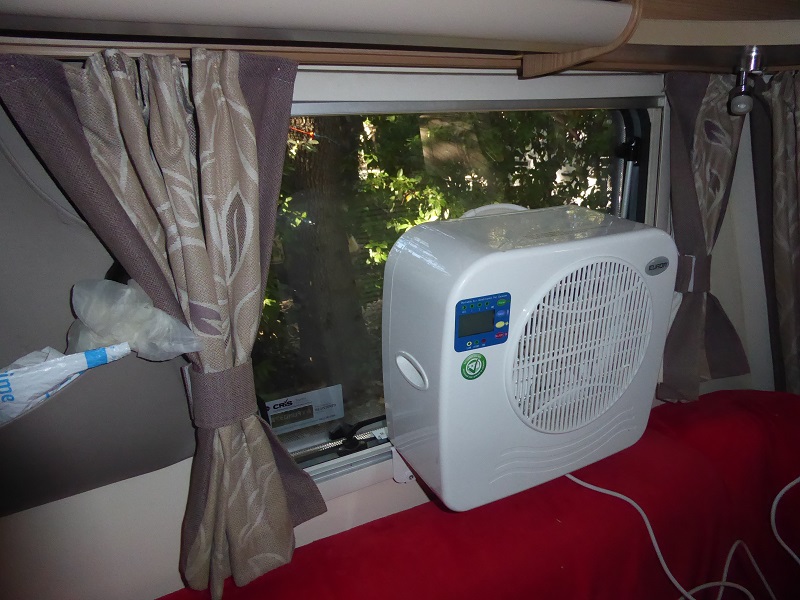
I can’t say we had much luck with this, as our unit was faulty, but the company was great to deal with & refunded us without question.
- Portable Split Air Conditioning Systems To Fit Campervan Windows
- Cool My Camper – requires 220V power, but is rated 450 watts/1.88 amps and is suitable for use on European sites where the hook- up supply is 6 amps or lower. It is designed to cool spaces up to 16 cubic metres.
- TEHONGMAI 12-Volt Split Air Conditioning Unit – this unit operates like the Cool My Camper, but works on 12V.
- Portable Battery Operated Air Conditioner
- Ecoflow Wave 2 Portable Rechargable Battery Operated Air Conditioning Unit – is quiet, has a very small footprint, and will run for 8 hours in Eco mode on the rechargable battery, which can be topped up from 220V mains, 12V, or a power station. Extra batteries are available, but they are pricey – in the high hundreds of pounds. This is the only unit which is truly portable, so you could use it on battery power in a tent, so long as you could carry it. It is designed to cool small spaces, up to 10 square metres, and has pipes which must run out of the windows/tent. There is a window vent board accessory to stop hot air coming back in, although it may not fit all windows. In winter, it can be used as a heater.
- Roof Mounted Air Conditioning Systems for Campers
- TEHONGMAI 12-Volt Rooftop Air Conditioning Unit – there are many options available. This one works from the 12-volt battery, but needs to be permanently fixed.
Other Tips
To Cool Yourself Down
- Take it easy – there is a reason that residents of hot countries take a siesta in the midday/afternoon heat and do stuff in the coolest parts of the day!
- Take a lukewarm shower, or apply a cool, wet flannel to areas with high blood flow, such as neck, wrists or feet. A cold foot bath will soon cool you down. A cold shower is less effective, since it constricts the blood vessels in your skin. This actually causes your core temperature to rise still further, as the blood can’t then get to the skin surface to lose heat.
- Cool drinks & keeping hydrated – cool or iced drinks help, although I also love a cup of tea, which is perhaps cooling because it makes you sweat. I know a cold beer is really refreshing, but alcohol, and caffeinated or sugary drinks, are dehydrating. It’s important to stay hydrated in hot weather, so drink plenty of water, AND:
- Replace salts lost through sweating.
World Wide Walkies REHYDRATION HACK!
A hack I used when windsurfing in hot climates was to dilute orange juice (not cordial) half and half with water, then add a tiny pinch of salt. (You should not be able to taste the salt!)
This will rehydrate you more effectively that water alone, and will replace your electrolytes in a similar way to expensive isotonic sports drinks.
Keep Cool At Night
- Ditch the duvet – obviously! We sleep under the duvet cover in summer.
- Use lightweight, breathable bedding and nightwear – natural fibres such as cotton, linen, or bamboo are the best. We particularly like Marks an Spencer’s Comfortably Cool sheets. Light polycotton bedding shaped for RV island beds, left- or right-hand cut off corner beds, twin beds, or bunk beds is also available.
- Cold Water Bottle – put cold water in your hot water bottle and even add a bit of ice, then take it to bed with you to keep cool.
- A damp sarong or dampened sheet over you at night will keep you cool for a while through evaporation. A plant mister is useful to spritz without soaking. The magazine Good Housekeeping recommends sticking your pillowcase or a pair of socks in the fridge before bed to cool yourself down!
- Cooling Mattress Topper – this gel infused memory foam mattress topper will help to keep you cool at night.
Help Your Fridge/Freezer
Like an air conditioning unit, your fridge works by removing heat from the inside of the box and venting it outside. Aiding this heat loss will help it to keep temperature, which will keep your food fresh and help you to have a ready supply of ice and nice cool drinks!
- Open and close the door as little as possible – cold air sinks, so every time you open the door, cool air drops on your feet and the refrigeration system has to cool down the warm air that enters.
- Keep the fridge/freezer full – air is difficult to cool, so the fuller your fridge/freezer is with cool stuff, the better, although do allow a little room for the air to circulate. We often freeze milk: frozen items in your fridge will help it keep cool.
- Use Fridge Organisers – these help to hold the cool air in the fridge when you open the door, a bit like the drawers in your freezer. They also make things easier to find, so you open the door for less time, and they keep the contents in place when driving.
- Shade the side of your van where the fridge is – but don’t cover the vents.
In Conclusion
- Do everything you can to stop your van heating up in the first place, even if you have air conditioning.
- Parking in the shade, near water, or at altitude is cooler.
- Cook outside.
- Create airflow naturally or with fans. Remember hot air rises.
- Evaporative or Swamp Coolers are less effective than air conditioning and create moisture.
- Air conditioning is suitable only if you have the payload, storage space, and energy to run it.
- At night, natural fibres are best for bedding and you might consider a cooling mattress topper.
- Be kind to your fridge and it will be kind to you!
Happy Travels!
Keeping Hot Dogs Cool
Dogs suffer in the heat. See my post 10 Tips To Keep Hot Dogs Cool In The Heat for the best ways to keep your canines comfortable.

10 Tips To Keep Hot Dogs Cool In The Heat
We all know that dogs die in hot cars. This is because dogs are not great at regulating their body temperature and can be overcome by heat frighteningly quickly. Permanent organ damage or even death can happen in a matter of minutes. If we travel to hot climates or as the summer temperatures soar…
Ten Tips for Travelling with Dogs
Including a free downloadable packing list! 1. Vaccinations & Parasite Treatments Visit your vet at least four months before travel abroad to make sure that your dog is up to date with all vaccinations and the most suitable parasite (worm, flea, tick, sandfly & mosquito) treatment for your destination, be that at home or abroad.…
More Tips:
For more advice, such as Planning The Perfect Trip, How to Record Your Travels, or Taking Your Dog to France, check out the Tips sections of my blog shown below:
Tips
The only silly question is the one you don’t ask. Here, you will find Top Tips gleaned from our experience as novice caravanners. From exploding toilets and killer caterpillars to explaining what gadgets…
The Wuff Guide to Travelling with Dogs
Here you will find links to my blogs containing helpful hints about issues that you will face when travelling overland with dogs. For information regarding flying with dogs, check out Travelnuity or the…

The Knowledge – RV Travel Tips
We’re not sage old timers like the man in the cover shot, but we’ve learned some stuff! Below, you will find practical tips and advice from our own experience of trucking and caravanning,…
Blog cover Image by rawpixel.com

 World Wide Walkies
My next door neighbours have just got a little camper van ( black, looks like the A Team! ) and have gone down to Devon for the weekend on their first trial run with the baby, leaving the aged retriever behind! Their plan is to travel round Europe for a month next year. They used to bomb around Europe and the middle east on motor bikes apparently so they should be good at travelling. Hope you don’t get too hot wherever you are at the moment.
LikeLiked by 1 person
Sounds FABULOUS!
We’re not hot at all at the moment. We headed for the hills because it was boiling in the centre of France, and did our laundry. The second we finished the last spin, the heavens opened! Now, we’re sitting amid a festoon of soggy undies. Livin’ the Dream.
Livin’ the Dream!
LikeLiked by 1 person
We have two roof fans in our truck camper. Turning one inward and the other outward has given us the best way of cooling the space off. Finding shade is not always easy and we have often tried to gain elevation in hot places with nearby hills or mountains. Sometimes it’s tricky to not park with the sun on the fridge side, depending on how we can get level. Luckily, our awning is on the opposite side of the fridge, so we usually try to park that side towards the sun in hotter climates. So much to consider! 🙂
LikeLiked by 1 person
I know – it’s not always easy.
At least with a few solutions in your tool kit, you can apply one or two.
LikeLiked by 1 person