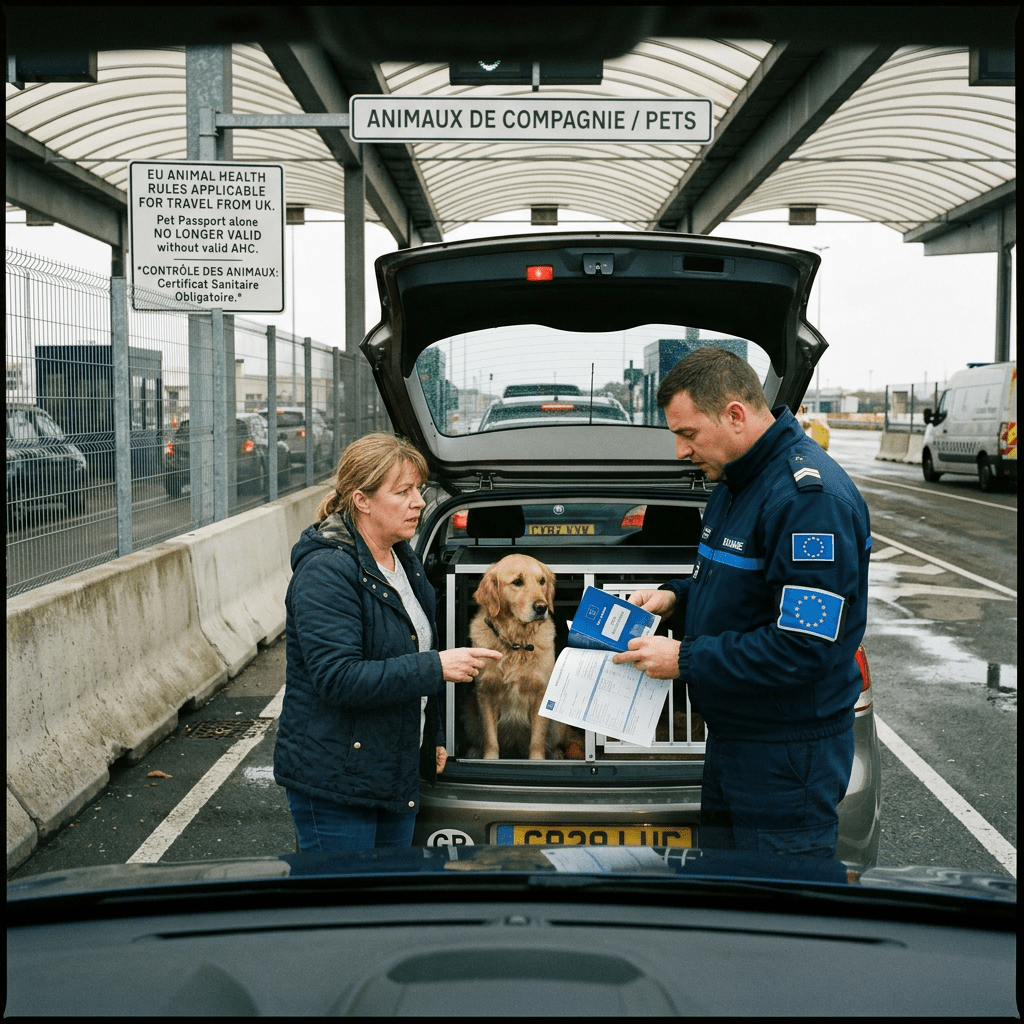
I’ve seen a lot of discussion on forums about the new EU pet passport rules coming into force during April 2026. As ever, there is a lot of misinformation and speculation, so I’ve tried to cut through to the facts.
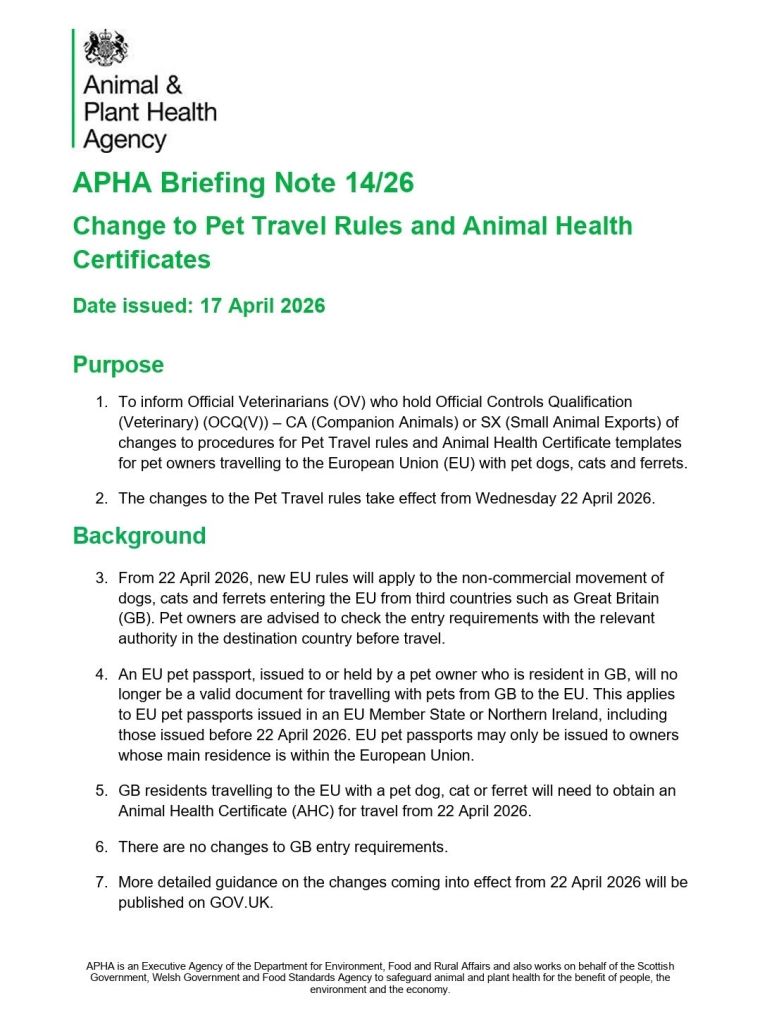
The AHPA (Animal and Plant Health Agency), a UK government executive agency under the Department for Environment, Food & Rural Affairs (Defra), issued Briefing Note 14/26 on 17th April 2026 to advise Official Veterinarians of changes made by the EU to the Pet Travel Rules which take effect from Wednesday 22nd April 2026.
It states that, “An EU pet passport, issued to or held by a pet owner who is resident in GB, will no longer be a valid document for travelling with pets from GB to the EU. This applies to EU pet passports issued in an EU Member State or Northern Ireland, including those issued before 22 April 2026. EU pet passports may only be issued to owners whose main residence is within the European Union.“
Here is a copy of the briefing note.
How This Came About
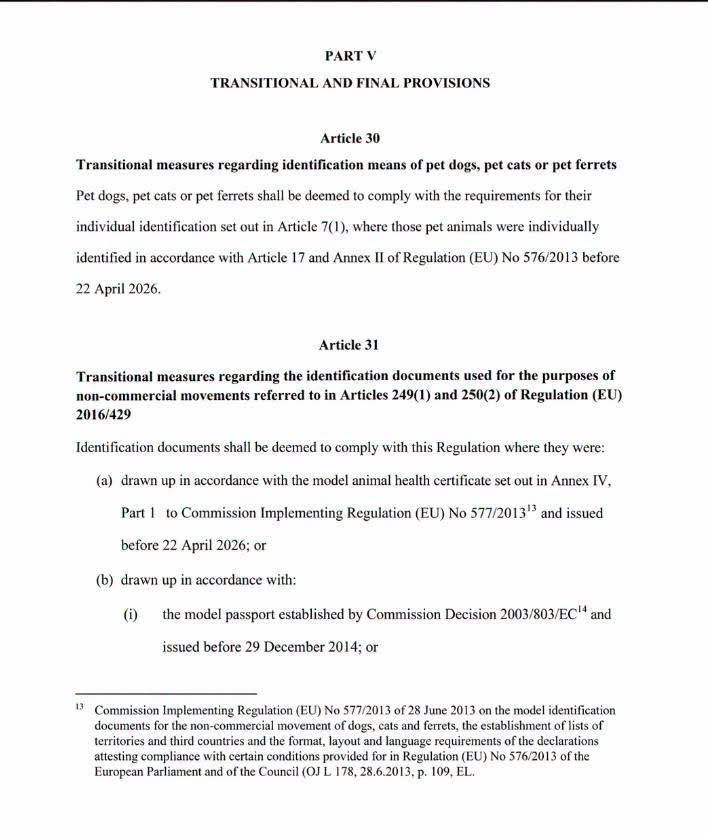
As of 22nd April 2026, the 10-year transition period for The Animal Health Law, EU approved Regulation (EU) 2016/429 ends.
The reason for the 10 year transition was the complexity of this legislation – one part of which covers the use of EU pet passports, including who can – and who cannot – use them.
Pet Passport Validity
A pet passport remains valid for multiple trips and for the lifetime of the pet, so long as the vaccinations are kept current. You would only need to replace the passport if the vaccinations lapse, or if you are a frequent traveller and one of the sections gets full.
There is information circulating that EU passports belonging to non-EU resident pets remain valid. I have had difficulty confirming whether or not this is true. Official guidance suggests not:
- Point 4 of the guidance above states clearly, ‘An EU pet passport, issued to or held by a pet owner who is resident in GB, will no longer be a valid document for travelling with pets from GB to the EU. This applies to EU pet passports issued in an EU Member State or Northern Ireland, including those issued before 22 April 2026. EU pet passports may only be issued to owners whose main residence is within the European Union.’
- Regarding pet travel, the Europa website also states clearly that, ‘A European pet passport is an identification document, which follows an EU standard model and is mandatory for travel between EU countries. The European pet passport (for dogs, cats and ferrets) is only issued to pet owners who are resident in the EU.’
- On Tuesday 21st April 2026, the wording on the UK government website offering advice on Taking Your Pet Abroad changed to reflect the new EU pet travel regulation. “If you live in England, Scotland or Wales, from 22 April you cannot use a pet passport (even if it was issued in the EU). If you use a pet passport, your pet may be refused entry into the EU. You can only use a pet passport if you live in Northern Ireland. Find out what you need to do in the DAERA guidance.”
HOWEVER
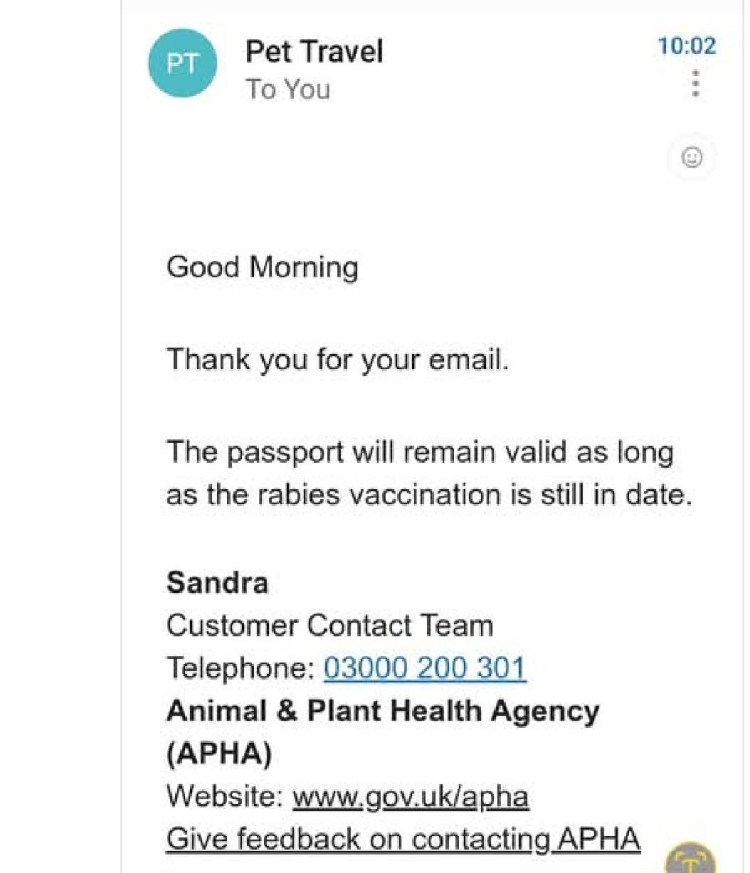
An email from the AHPA confirms that the passport remains valid so long as the rabies vaccine is up to date.
Note that in the past, I have had completely contradictory emails from the same government department on whether you could have animals of different species on the same Animal Health Certificate – eg a dog, cat, and ferret. One said no. The other said yes! The latter was correct, but it’s very confusing when you get incorrect and conflicting information from the horse’s mouth, as it were!
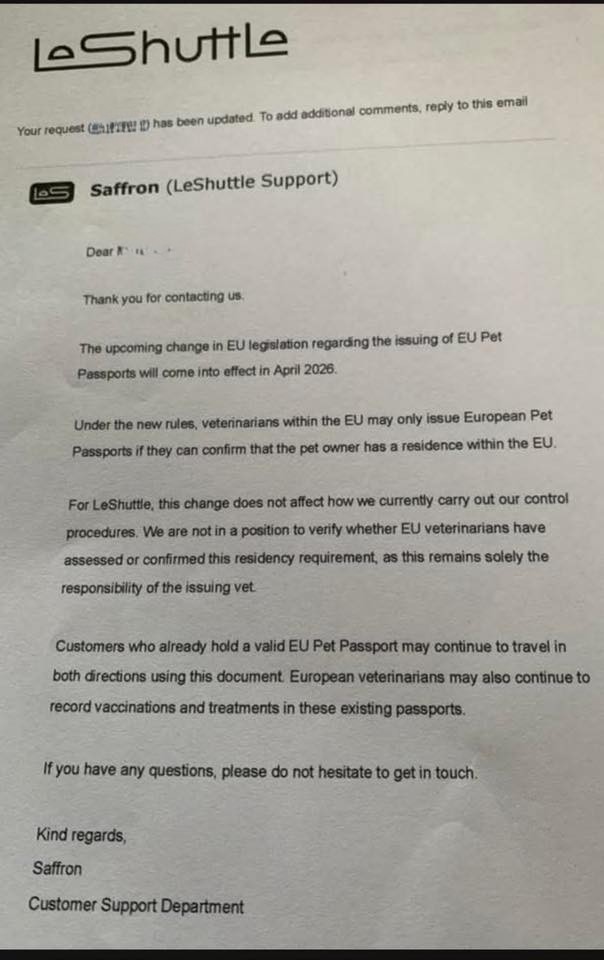
Confirmation email from Eurotunnel Le Shuttle stating that they are not in a position to check residency and will continue to accept EU pet passports for travel in both directions.
This is confirmed on their website as of 20th April 2026. Here is the text taken from Le Shuttle website in case they change it.
Pet travel update from 22 April 2026
From 22 April 2026, EU Pet Passports can only be issued to pet owners who can provide proof of EU residency and a permanent EU address. EU Pet Passports issued before this date can continue to be used while valid. For the most up‑to‑date and official guidance, please check GOV.UK before you travel.
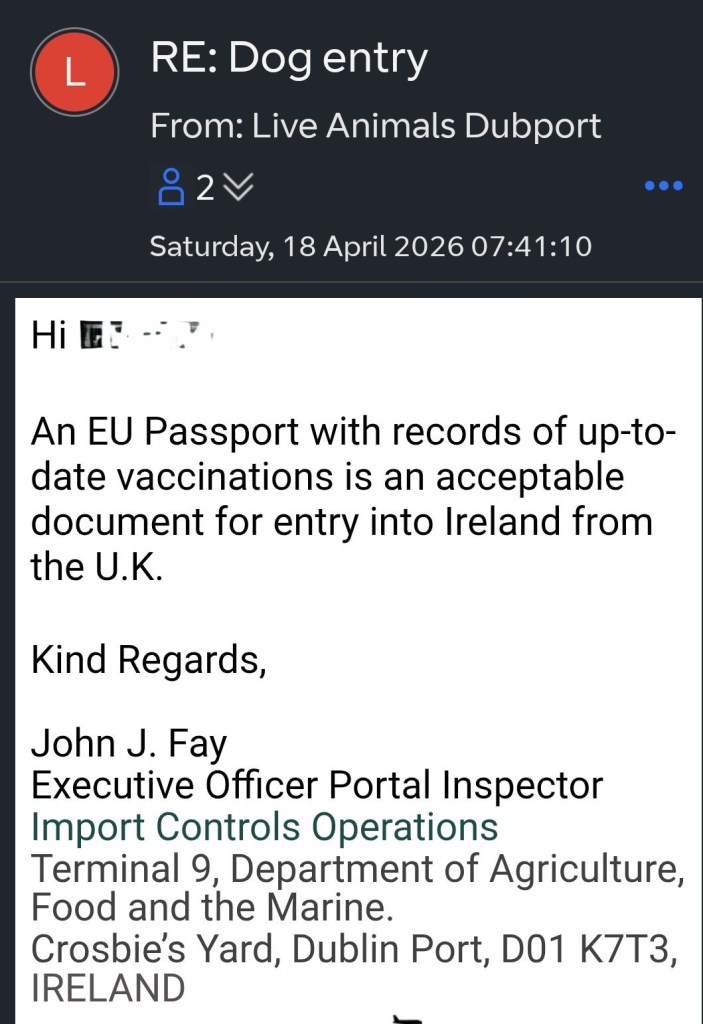
Dublin port states that it will accept an up to date EU pet passport from UK into Eire.
Travel from the EU into GB – No Change
At the time of writing, the UK GOV website states that valid passports (including those issued in the EU) can be used to enter GB.
The requirement for the mandatory tapeworm treatment also remains unchanged.
The Reintroduction of the UK Pet Passport
Following UK government talks with the EU, the framework is there for the return of UK Pet Passport, but no timescale yet announced. See my post Reintroduction of UK Pet Passports: A Gateway to Freedom for British Pets for more information.
What The Changes Mean in Practice
The Letter of the Law
Technically, official documentation suggests that from 22 April 2026, GB residents travelling to the EU with a pet dog, cat or ferret will need to obtain an Animal Health Certificate (AHC) each time they wish to enter the EU.
For those pets without EU passports, the requirement for an AHC has been the case since the end of the Brexit Transition Period, when, except for Northern Ireland, UK-issued pet passports became invalid overnight. For more information on AHCs, check out my post Animal Health Certificates – What You Need To Know which includes links to providers of low-cost AHCs.
The AHC is a 10-page bilingual document which is valid for a maximum of 4 months and only for a single entry into the EU. So, if you travel with your pet outside the EU, for example to common Schengen Shuffle countries, you will need another AHC to re-enter the EU. Note that if you visit high rabies risk countries such as Morocco or The Balkans, your pet will also need a valid rabies blood titre test to re-enter the EU. This test is difficult to obtain in many countries outside the EU, and if carried out outside the EU (e.g. in Britain!), even if your pet passes, it is not valid for travel until 3 months after the blood was drawn.
Interpretation of the Law
The legal framework seems clear – according to official sources, it looks like residency matters, but the grey area comes in the form of interpretation and enforcement, which is up to individual EU border authorities.
It’s a new regulation, so the confusion is as usual, and the rigour with which it will be applied remains to be seen. Shortly, we will be travelling from Morocco to Spain with five dogs – The Fab Four and a stray we picked up on our travels – so we will learn first hand about it then!
In the meantime, here are my thoughts.
- The EU Schengen area is borderless, so there are limited checks on paperwork once you’re inside the EU. (Illegal migration does lead to occasional checks at some borders, so it can happen. We have been stopped – but the dogs’ documents were never checked.)
- Other than crossing from France to GB and back again, in 10 years on the road and after visiting over 30 countries, our pets’ passports and paperwork have NEVER been checked, even when we have entered the EU from countries considered a high rabies risk. This does not mean you won’t be checked. Occasionally spot checks or crackdowns happen, so there are no guarantees and you do this at your own risk.
- An email to the Pet Travel Expert at Britanny Ferries stated that, “Nothing has changed for entry into the UK. We have been advised by the authorities in our ports in France and Spain that they are not implementing those new rules for the time being.“
- Requirements to enter the UK remain unchanged. You need a valid pet passport or AHC, and the Echinococcus (tapeworm) treatment administered between 24 and 120 hours (5 days) prior to ARRIVAL in the UK. At the time of writing, the UK GOV website states that valid passports (including those issued in the EU) can be used to enter GB.
- The ‘EU pet passport workaround’ works for GB pets because interpretation and enforcement is inconsistent, but refusals can happen!
Conclusion
Depending on interpretation and how rigorously this is enforced, it seems it might still be possible for a non-EU-resident to travel on an EU pet passport. The situation will become clearer with time. As ever, the implementation is all a bit last minute – with some ports saying they have not yet received the full information!
However, if you have an EU pet passport, are not resident in the EU, and want to remove all risks of being stopped at the border and having your pet refused travel, a valid Animal Health Certificate removes all ambiguity.
This is a new and developing situation. Please note that while I make every effort to provide correct and up to date information, referencing primary sources, any use of this information is at your own risk. Please see my Disclaimer for details.
Additional Information
Parasite Protection & Other Travel Requirements
A pet passport or AHC is not a cover-all for international travel with pets. Besides the requirements of the passport, some countries have their own specific entry requirements. Pet Travel.com lists the entry requirements for over 200 countries. Since requirements change frequently, do double check with the official website of the countries that you will be visiting.
Look out for things like:
- Countries who do not recognise the 3-year rabies jab and require annual boosters.
- Countries which require a rabies blood titer test to prove that the rabies jab is effective. If done in a non-EU country, such as the UK, it takes 4 months (or longer if your test fails!) before your dog can travel. Note that a rabies blood titer test is required to re-enter the EU and UK if you travel to an unlisted high rabies country. This can include many Schengen Shuffle countries, such as the Balkans, Morocco, or Turkey, and often catches travellers out. Get a rabies blood titer test if you intend to visit any unlisted countries.
- Countries who require their own AHCs for pets to enter, such as Albania.
- With or without a pet passport, some countries still enforce quarantine.
In addition, you should consider other health needs of your pet which are not covered by the passport.
Important health considerations are as follows:
- Tapeworm (Echinococcus) Treatments – with or without a pet passport, treatment against Echinococcus multilocularis remains a requirement for entry or re-entry into the UK, Eire, Finland and Malta. It must be administered by a vet and, along with a health check, recorded in the passport in 24-hour clock format between 24 and 120 hours (5 days) before entry into the destination country.
- Rabies Blood Titer Test – If you travel outside the EU to unlisted countries, eg to many Schengen Shuffle countries, such as Turkey, Morocco, or the Balkans, your pet will need a valid rabies titer test certificate to re-enter the UK and/or EU. This requirement catches a lot of people out, since they just look at the entry requirements for the countries they are visiting, not how to return to their country of origin.
- Local Disease Protection – check with your vet that your pet is fully vaccinated for other doggie diseases and is appropriately protected for local risks, such as parasite- and disease-carrying mosquitos, ticks and sandflies, since these are not covered by the passport or AHC. See my post on Travelling from the UK to Europe & Back with Dogs and my post on Leishmaniasis.
Since you are officially exporting your dog to the EU for the duration of your holiday, you must comply with the guidelines set out by the APHA. It is YOUR responsibility to ensure that your documentation is appropriate for the countries you wish to visit and that any additional local requirements are met.
In The Meantime…
Since this is a developing situation, stay tuned and I will make sure to keep this post updated. Or check for updates on the pet travel section of the .GOV website.
Yappy Travels!
Related Posts
Check out The Wuff Guide to Travelling with Dogs for more information on doggie travel requirements, including:
- Travelling from the UK to Europe & Back with Dogs
- Can I Get My Dog an EU Pet Passport?
- 10 Things you Need to Know About Taking your Dog to France!
- Travel With Dogs to Albania – What You Need To Know
- Slovak Paradise (Slovenský raj) With A Dog
The cover photo for this blog is an image generated by WordPress AI. The rest of the post is all human generated!

Walk With Us!
For More Advice & To Follow Our Adventures, Sign Up Now!
Copyright © 2023 WorldWideWalkies.com – All rights reserved.
 World Wide Walkies
It is great that you are spreading this information. It does not effect me but I can see how it effects many other people.
LikeLiked by 3 people
Thank you, Thomas. It’s a huge blow to travelling pets and another benefit of Brexit – the gift that keeps giving!
Hopefully, we will see the return of the British pet passport next year. 🙂
LikeLiked by 2 people
Yes I certainly hope that happens
LikeLiked by 1 person
Thanks for that jakie I am considering adding a Belgium address to lunas passport after our chat yesterday. But still not sure guess as you say worst case ill get ahc from morocco x
LikeLiked by 1 person
It’s a pleasure, Dave.
Since we have to get an AHC for Max before we travel, I can let you know how much it is. None of the vet treatment he’s had in Morocco has been expensive, so for peace of mind, it might just be the easiest route. If it’s not too expensive, we might get AHCs for The Fab Four.
It will be interesting to see how it goes at the port, since friends who have gone out of Tanger Med all reported that their dogs’ paperwork was not even checked, but there is scope for that to have changed with the new regulations.
I shall keep you posted 🙂
LikeLiked by 1 person
Thanks for the detailed write-up, Jackie. We had seen the chaos and worries online about this new development as well and we will have to see how it plays out. We (finally) got a European pet passport for Maya in Spain (as you know) as non-EU residents and truly hope we will be able to use it. The whole thing about needing new health certificates when crossing borders is something we are used to – and sick of – from South America. It is time consuming, inconvenient, and pricey.
LikeLiked by 1 person
It is just bonkers.
At least we can use the EU passports to enter GB – so we don’t have to get AHCs for that AS WELL as apparently needing one to enter or re-enter the EU!
I will be keeping an eye on things as well to see how rigorously it’s enforced, so we’ll see how we go!
LikeLike
Hi, I’m new to this so apologies if I make any mistakes. Both of my dogs were adopted in Spain,so have Spanish passports,and all of their vaccinations etc are done in Spain in accordance with Spanish law. I own a property in Spain where we spend several months each year,but I am not a resident,so alternate between there & the UK,the dogs travel with me several times a year. The dogs are registered to my address in Spain,but I’m not a resident,so I guess we fall into this administrative trap,we are currently in the UK until July. So to avoid this hassle an EU resident friend has agreed to register the dogs with her until the UK passport is sorted out, she’ll write a covering letter for when we travel,stating that I have her permission to take them with me etc. Can anyone tell me if this will be sufficient,or am I panicking unnecessarily? Thanks Lewis
LikeLiked by 1 person
Hi Lewis, there is no judgement on my blog, so don’t worry about that! I’m afraid I can’t give you a definitive answer, though. I would have thought that if common sense prevails, that a covering letter stating that the dogs are resident in Spain would suffice, but there are no guarantees of common sense…
It will be interesting to see how stringently the new rules are enforced. I will be keeping my eyes on pet travel forums to monitor real-world feedback from travellers. We shall be putting it to the test ourselves shortly as we have to cross back into Spain from Morocco.
I’m sorry I can’t give you a definitive answer on whether you will get away with it – it is still circumventing the rules slightly.
In truth, the only failsafe way is to get an AHC, but I would have thought that your situation gives you the best chance next to residency to succeed with travelling with an EU passport. It remains to be seen whether staff at the ports will ask for proof of residency for the many many British pets who travel on EU passports.
At least the British government has said it will accept EU passports for entry, so you won’t need an AHC to come back!
It’s just madness, I know 🙂
LikeLike
Thanks for your reply,best of luck on your travels!
LikeLiked by 1 person
You’re welcome – and thank you! We’re lovin’ our travels in Morocco – I really need to start blogging about it, but have been busy finishing my latest book and organising the launch…
Note that Eurotunnel has put a note on their website in the last day or two stating that they will accept EU passports in both directions.
It remains to be seen how this madness pans out.
It’s funny, but my brilliant lateral-thinking husband came up with the same solution as you completely independently and out of the blue – to get a friend to give us a letter to say the dogs are resident in the EU!
Ours are on French passports, so it might be more difficult, because France now requires pets to be registered on the ICAD system, although I can’t imagine port authorities going into that level of checking.
LikeLike
Hi again, don’t know about the french system,but I did a bit of research. There are vets near the channel ports who do AHC online,to take mine across would cost £129,not ridiculous but an expense. They accept the passports as evidence of the rabies jab & for the chip confirmation so that’s the way to go for the time being,I guess
LikeLiked by 1 person
I have outlined a few AHC suppliers on my post https://worldwidewalkies.blog/2021/06/23/animal-health-certificates-what-you-need-to-know/#where-when-can-i-get-an-ahc The cheapest is £69 for returning customers. You can have up to 5 pets on a single AHC. There is usually a small additional charge to the upfront cost for each additional pet, so £129 for two sounds about right.
Best of luck and happy travels 🙂
LikeLike
thanks very much for the info
LikeLiked by 1 person
You’re welcome. Hope it all helps make sense of a very confusing situation 🙂
LikeLike