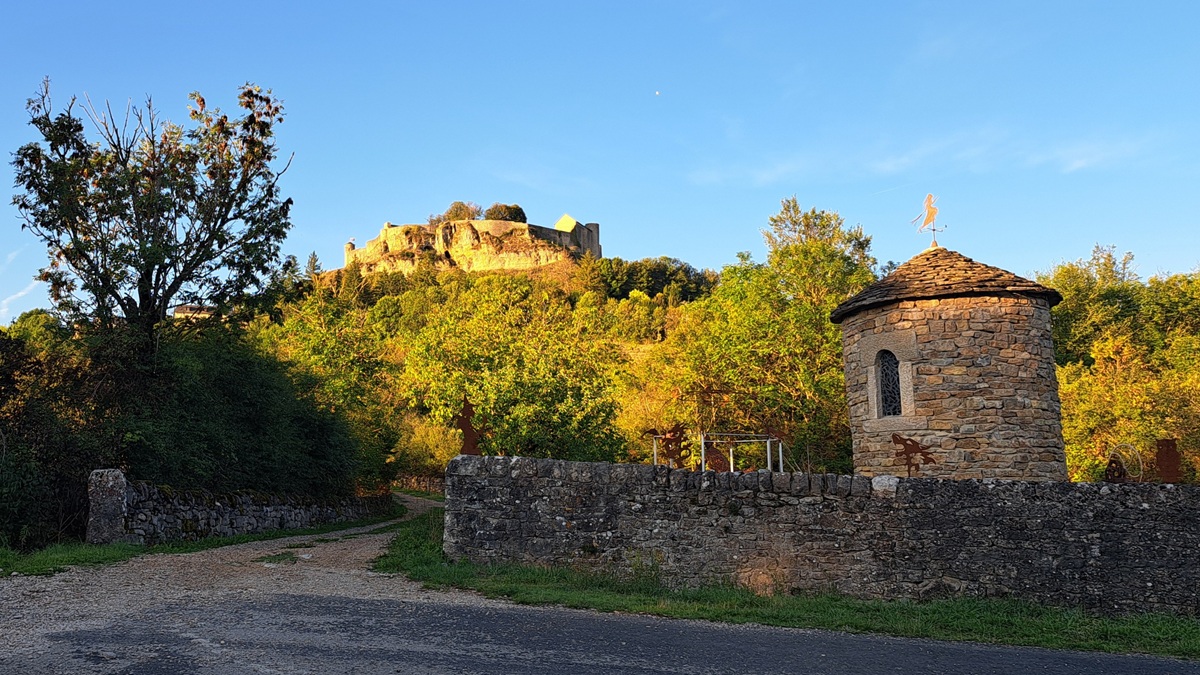
In Southern France, history is not confined to individual locations, museums, or monuments; it is embedded throughout the landscape.
During the medieval period, Sévérac-le-Château or Sévérac d’Aveyron sat on a geographic, religious, and political fault line. On the edge of a region with a fiercely singular identity, it was caught between the Mediterranean world of the Cathar religion – condemned by the Catholics and Rome – and the tightening grip of power imposed by northern France.
For us, Sévérac is where the past got personal.
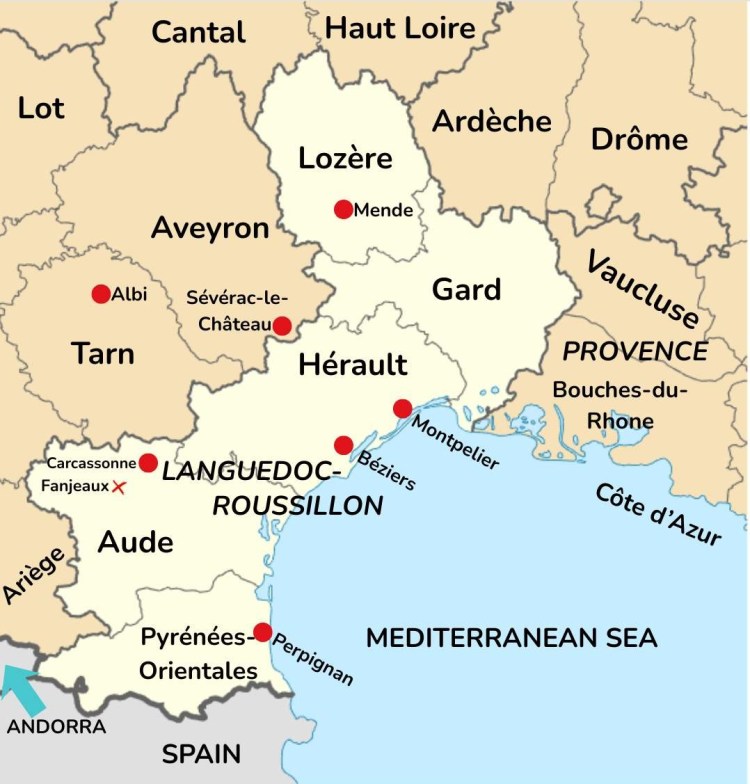
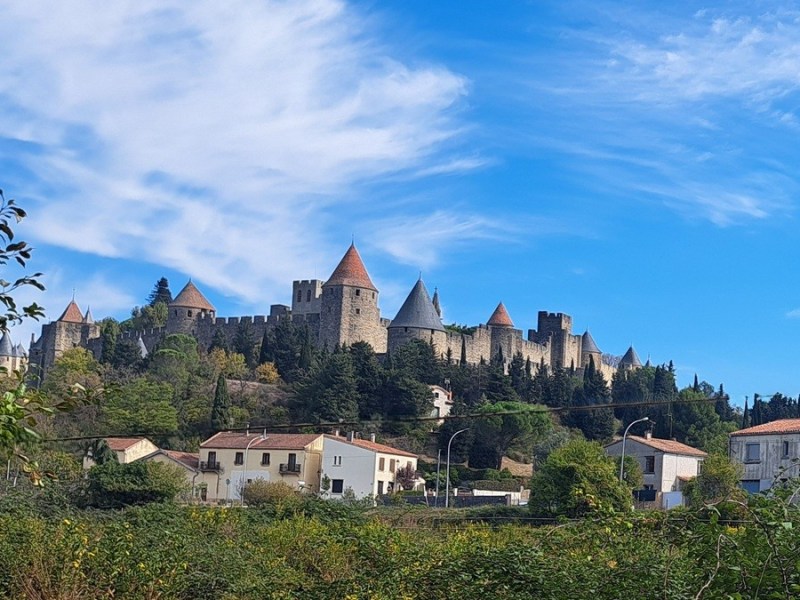
Beneath the ramparts of a hilltop castle established in the 11th century, stories on dry pages transformed into ancient stone underfoot, and routes once trodden by marching armies. Dominating the Aveyron plain, Sévérac’s hilltop fortress survived the violent eradication of the Cathars in the 13th century Albigensian Crusade. Then it rose like a phoenix in the 14th and 15th centuries, remodelled by Louis d’Arpajon as a sumptous Renaissance dwelling, allegedly by the Italian architect who designed the royal palace in Prague.
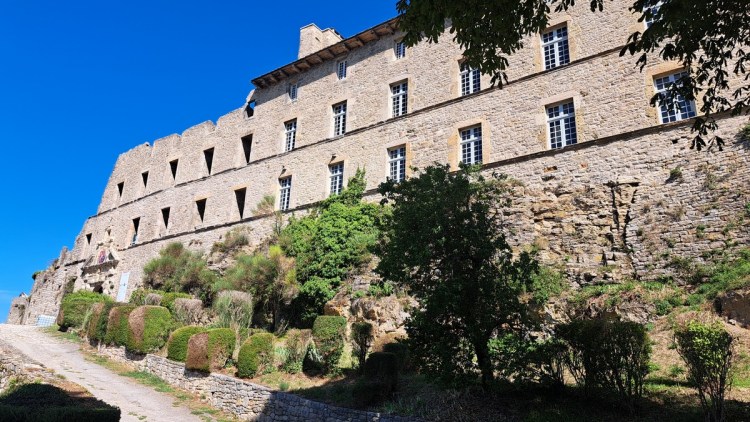
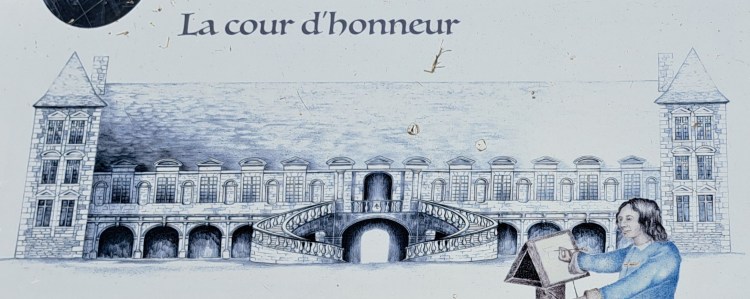
Inside the vast castle interior, we saw the remains of the monumental horseshoe staircase to the rear of the north facade, which embraced the castle entrance and led from the arcaded first floor of the palace into the cour d’honneur – the courtyard of honor. It mimics the iconic grand horseshoe staircase (Escalier en Fer-à-Cheval) at King Louis XIII;s Château de Fontainebleau. As a King’s general, Louis d’Arpajon undoubtedly saw this, and commissioned his own.
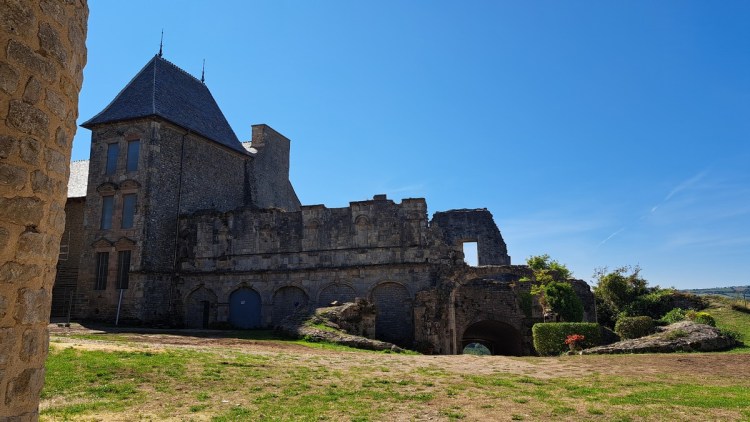
modelled on the one at King Louis XIII’s Château at Fontainebleau
Long before the bastides – the new towns – imposed order on the Languedocian population, châteaux such as Sévérac stood guard over contested land. This was border territory – not yet pacified – but already shaped by the tensions that would come to characterise what is now characterised as Cathar Country.
Though not a Cathar stronghold itself, Sévérac served as a defensive refuge for dispossessed Cathars. It was strategic and heavily fortified, and the siege and capture of the castle in 1214 places it squarely in the brutal reordering of the Languedoc.
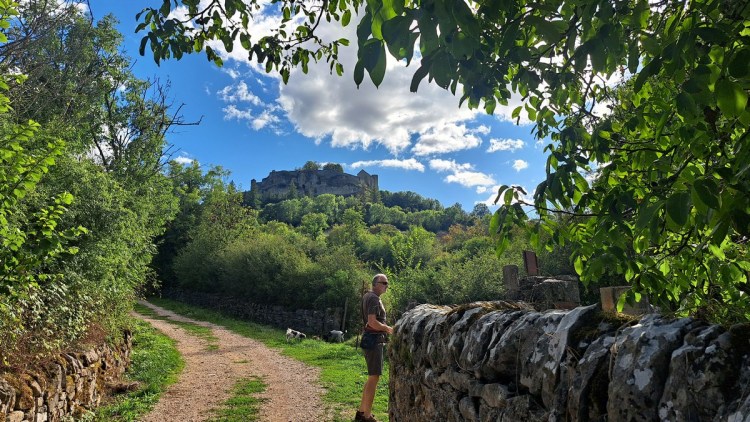
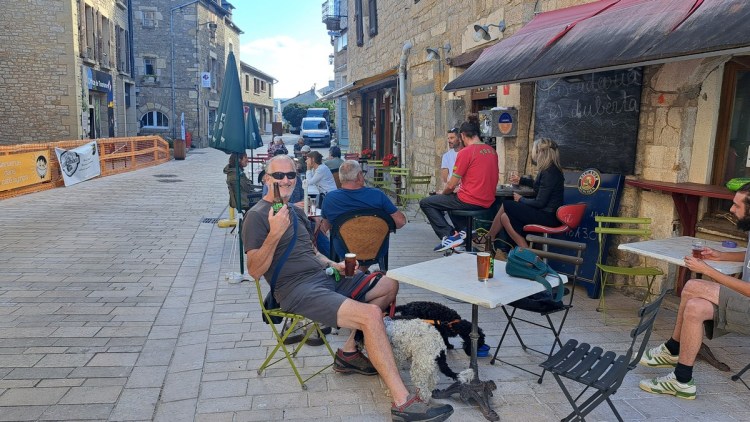
We arrived on a beautiful, balmy September evening and opted to save the castle for the morning. But it seemed rude not to wander up the hill into the old town itself. Although it was getting late, the tourist office was still open, so I dived in and emerged with maps and leaflets. Then we found a friendly bar and, following a long hot drive, ordered a well-deserved Friday night beer.
Perched peacefully above the A75, Sévérac doesn’t shout for attention. It does not have the theatrical drama of some medieval sites, nor the polish of places that have learned to perform for visitors. Instead, it feels lived in – somewhere that happens to have survived the Middle Ages but is not preserved in aspic. It drew our attention simply because we can’t resist a good castle.
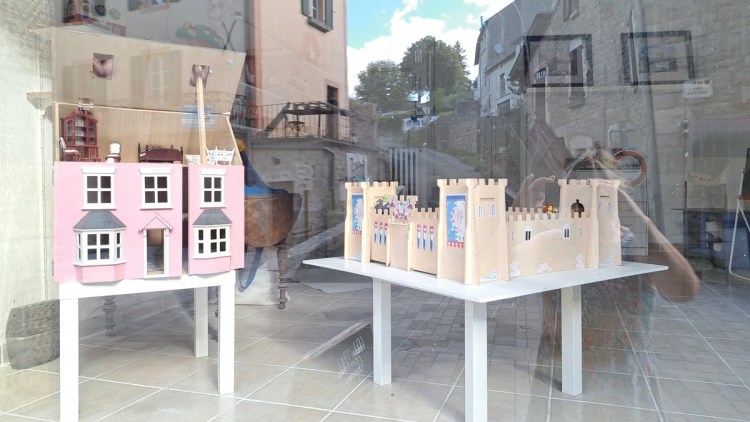
A few days before, we’d watched an episode of the comedy panel show Would I Lie To You? in which team captain David Mitchell became wildly excited about Alan Titchmarsh’s four-storey Georgian dolls’ house. Across the road from our bar, a shop window displayed both a dolls’ house and a mini castle. Had famously fortress-loving Mitchell seen that juxtaposition, I’m sure he would have spontaneously combusted.
Sévérac had a warm, convivial feel. It was no medieval theme park. As we sipped our beers, locals greeted one another with hugs, settled down with drinks, and enveloped the barman’s young children with cuddles when they turned up to visit Dad. The only thing that slightly tarnished the idyll was the traffic. I did delight in the unique Frenchness of a vintage Citroën 2CV squeezing along the narrow street, but was less enamoured with the romance of a caravan trundling past, narrowly missing our table! But at exactly 6 p.m., the barmaid blockaded the road – albeit only at our end. Each time a vehicle appeared from the other direction, she had to dash out to open it.
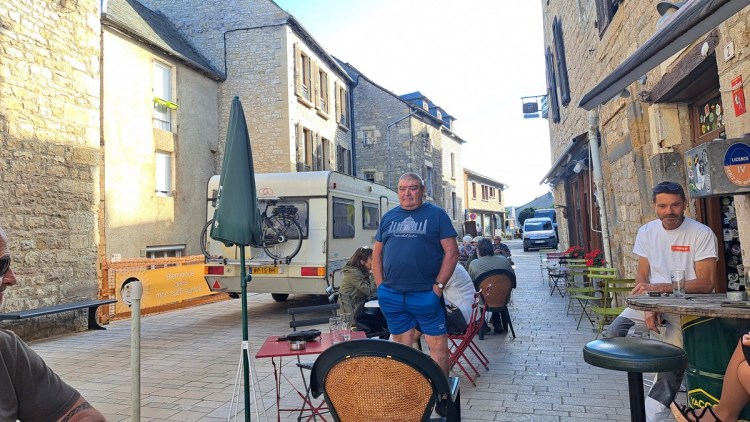
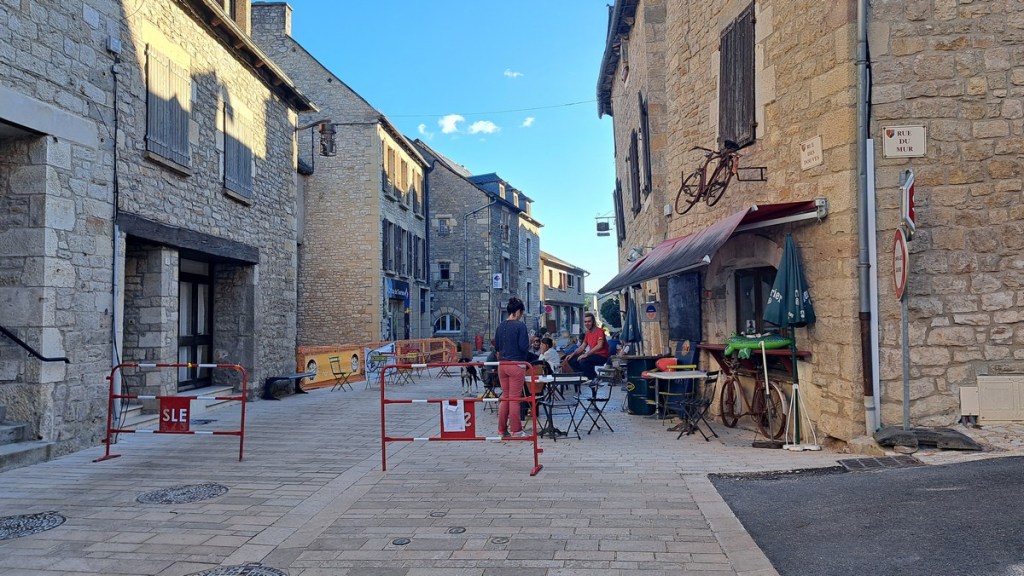
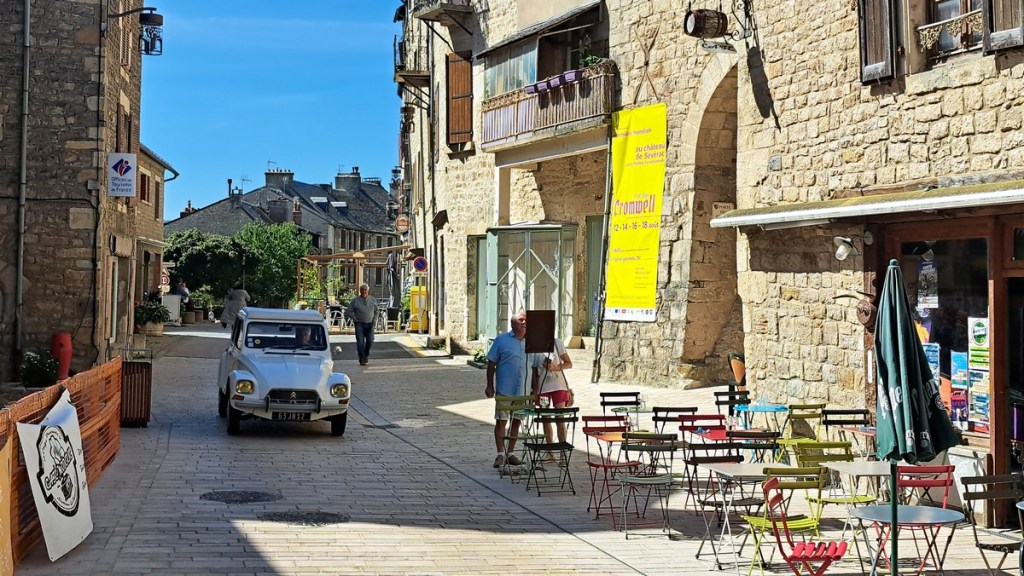
Above – a caravan narrowly misses the tables of the pavement cafe, the 6 p.m. street blockade, & a 2CV!
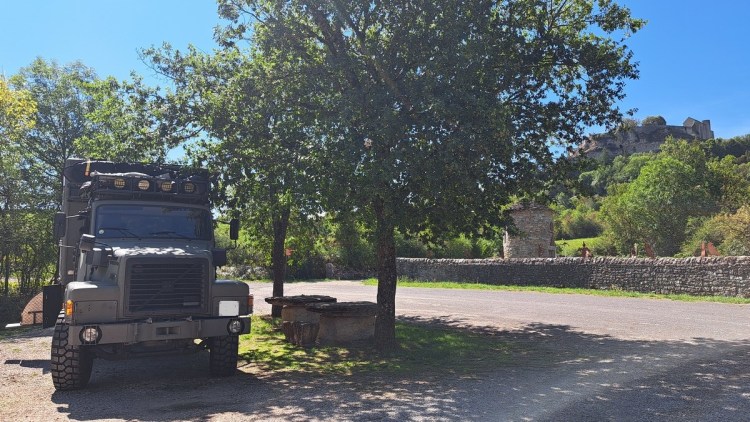
Back at The Beast, dinner was gloriously simple. We’d picked up a roasted chicken at the supermarket in Mende. Completely alone at the foot of the hill beneath the village – far preferable to the cramped and crowded aire du camping car in the centre – we spent a peaceful evening poring over brochures, planning a proper exploration of Sévérac-le-Château.
The following morning, in deference to my careful preparation, Mark announced, “You’re the guide for today!”
Well, frankly, I could not have done a better job.
Halfway up the hill leading to the castle, I realised I’d not only forgotten the map, but the extra piece of paper that translated it into English. Fortunately, when we got there the tourist office had opened, so I grabbed another map. However, to save paper, I decided to brave it in French.
I set off confidently, but couldn’t find any of the sights. When we reached the Place de la Liberté, I realised we were still on the main road – we hadn’t actually entered the medieval city at all. At least that explained why we’d missed everything. We retraced our steps and accessed the walled city through one of the two remaining portcullised gates. (Originally, there were four.)
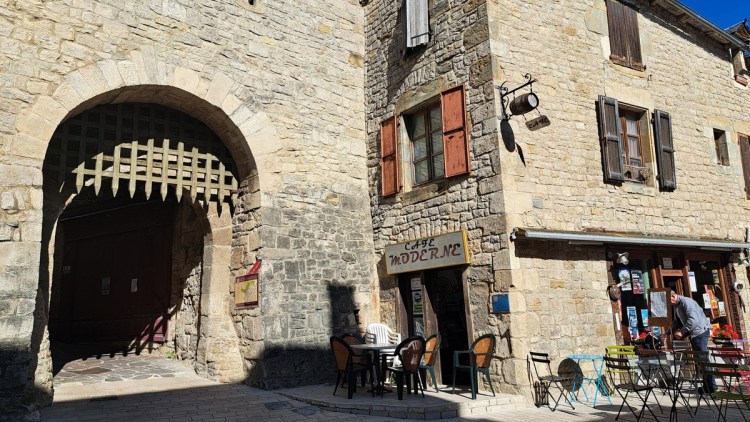
From there, Sévérac unfolded quietly and beautifully on its sunny southwest-facing incline. Its narrow, cobbled streets bordered by pale sandstone houses, the delicate hue of translucent acacia honey. We climbed to the church past the lavoir, the communal washing area. A stone trough nestled into the hillside beneath a beautiful arch, with a lane running over the top.
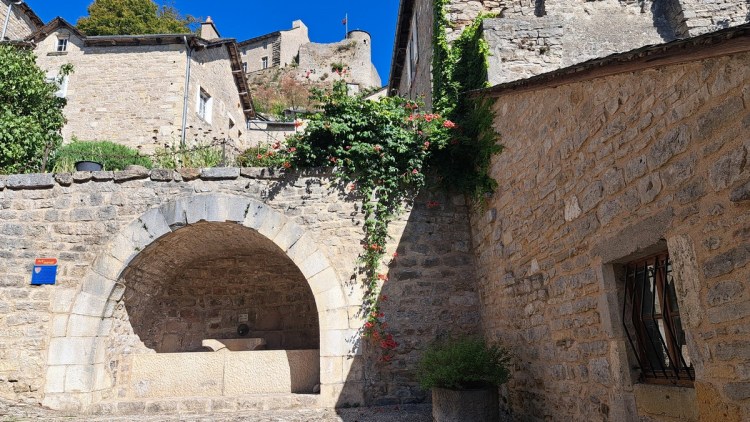
“I used to use lavoirs when we toured France in the Transit van,” Mark said fondly, recalling the working trip from his youth.
How useful to have a washing area with free water for grubby teenage van-dwelling nomads!
We almost walked past the Roman fountain, tucked away in a minimal dark recess covered with wire. I spotted it only because I read the sign in French that announced its understated presence. Even after we’d visited the château, Mark said that this truly ancient link to antiquity was his favourite thing.
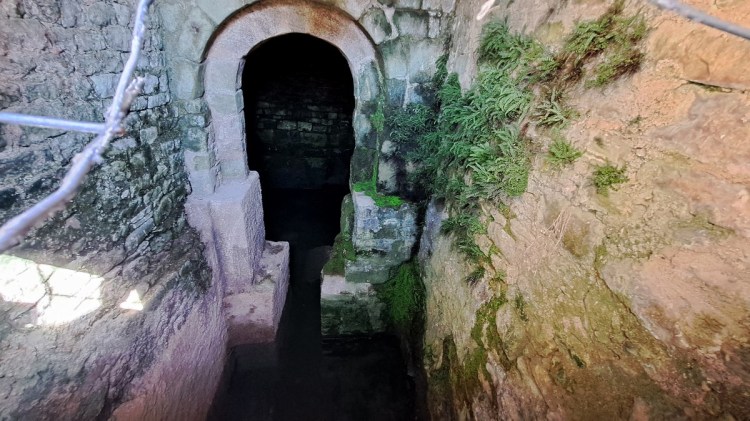
We didn’t take the conventional route to the castle. A tiny ginnel caught my eye, so I followed that – I am always drawn to a hidden little alleyway!
The fortress itself had a real atmosphere, and we had it almost to ourselves. From an information board, I learned that Simon de Montfort, Earl of Leicester, besieged it in 1214. His name seemed oddly familiar. Intrigued, I discovered later that this was not the Simon de Montfort celebrated as a pioneer of English democracy, but his father.
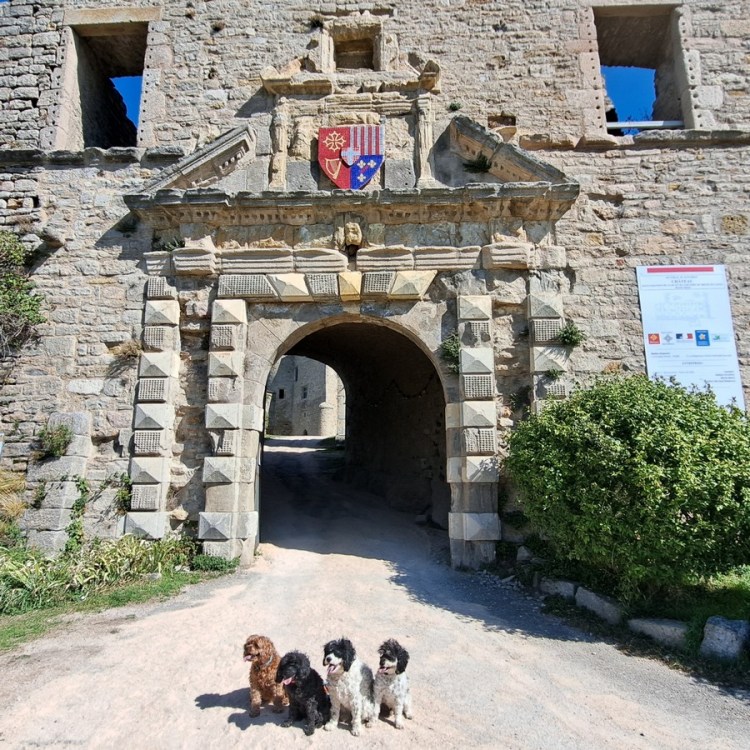
Simon de Montfort the Elder was a French nobleman – and ruthless military leader. Pope Innocent III sent him south to lead the Albigensian Crusade, intended to crush Catharism and bring the Languedoc to heel. Known for uncompromising violence, de Montfort left a wake of devastation and sanctioned some of the Crusade’s worst atrocities. This included mass murder and the destruction of entire cities, which brought about the brutal destruction of the Cathars.
Although his son, Simon de Montfort the Younger, inherited the same name and title, he pursued a rather different path. England remembers him for challenging absolute royal authority – he led baronial opposition to King Henry III’s dictatorial rule – and, in 1265, he summoned the first Parliament to include representatives of ordinary citizens, or ‘commoners’. During his brief control of England, he reissued the Magna Carta – known as the Montfort Magna Carta – the charter of rights that established the principle that even the monarch is not above the law.
That said, the younger de Montfort wasn’t all sweetness and light. He persecuted England’s Jews – expelling them from Leicester, cancelling debts owed to them, and massacring scores in several other English towns.
Same name, same title, somewhat divergent legacies – but in the end, the same fate. Father and son both died fighting – the Elder at the Siege of Toulouse, the Younger at the Battle of Evesham – a grimly fitting conclusion for two men whose lives, for all their differences, were still marked by bloodshed, repression, and the ruthless exercise of control.
In Cathar Country, the name Simon de Montfort is tied irrevocably to slaughter and suppression, yet in England, it evokes representation and reform. Leicester’s De Montfort University commemorates the younger Simon de Montfort – the 6th Earl of Leicester. A quiet reminder that history has a selective memory, its heroes are nuanced – and often remembered in ways that don’t ‘fess up the whole story.
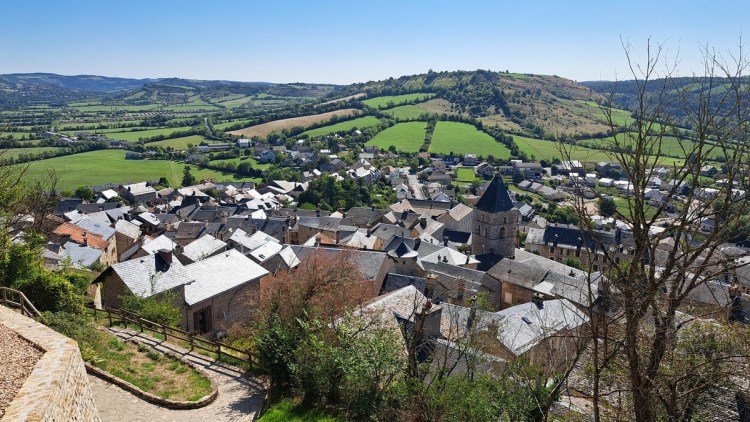
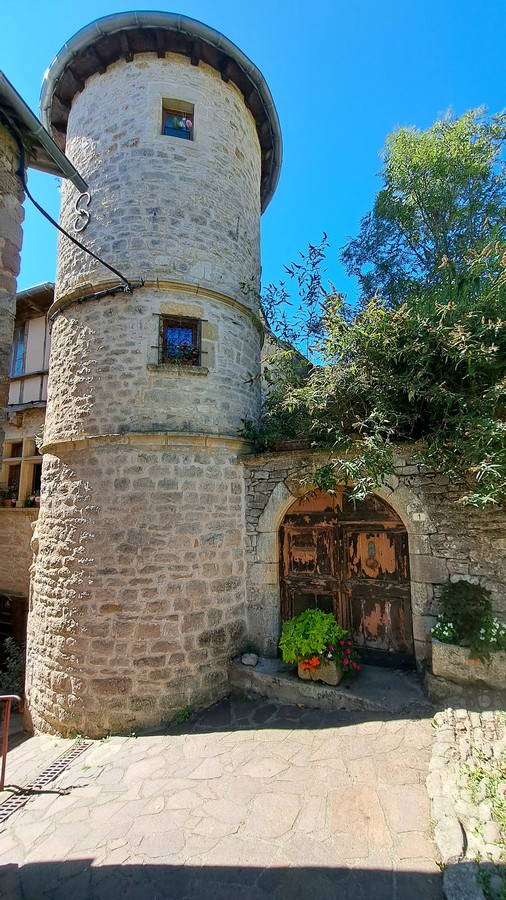
From the castle’s ramparts, the views in two directions over the rooftops to the rolling hills and green fields of Aveyron were outstanding, with a cool breeze cutting through the simmering heat.
The medieval buildings had beautiful fish-scale slate roof tiles, which seemed typical of the area, and few of its homes had towers.
I would love to live in a tower!
I wanted to see la Maison de Jeanne – the House of Jeanne (Joan), the oldest in the region.
“This must be the way,” I said, following a sign near the castle that pointed to the village centre.
“Yes.” Mark smirked. “That’s the way we came.”
I ignored his sarcasm, flounced down the steps and emerged onto one of the main streets, where someone had placed spooky masks in a few of the windows.
We were back in town, but not back on track. I checked the map and announced, “We’ve missed the House of Jeanne! We’ll have to go back!”
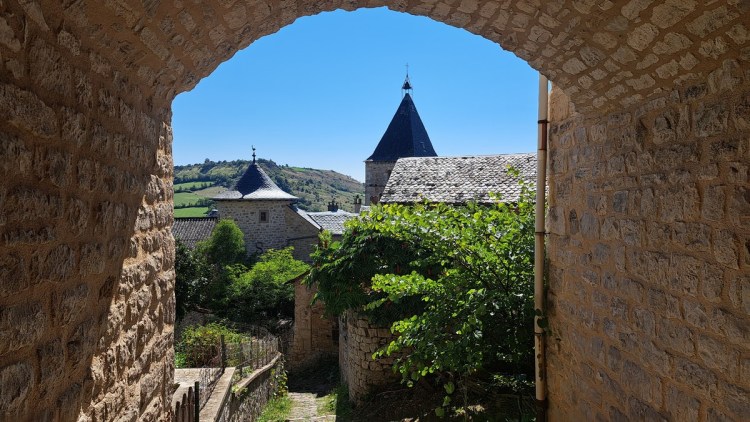
Mark grimaced, unimpressed. But Sévérac’s twisting labyrinth of lanes is forgiving of the directionally challenged. It is so compact, it took barely a minute to correct my mistake.
“You should be grateful,” I told Mark. “You’ve had a tour that no one else has!”
It was certainly original.
As was the Maison de Jeanne.
Historians dated the timbers in the cob and frame construction to the spring of 1478. As with many buildings from that period, its two upper storeys are jettied – they jut out in stepped overhangs over the street below. This was not decorative bravado on the part of medieval builders, but entirely practical. Jettying created extra living space without increasing the footprint or encroaching onto thoroughfares – valuable in a walled town where land was scarce. It also helped keep rainwater away from the lower walls, and could reduce taxes where authorities based them on a property’s ground-floor area.
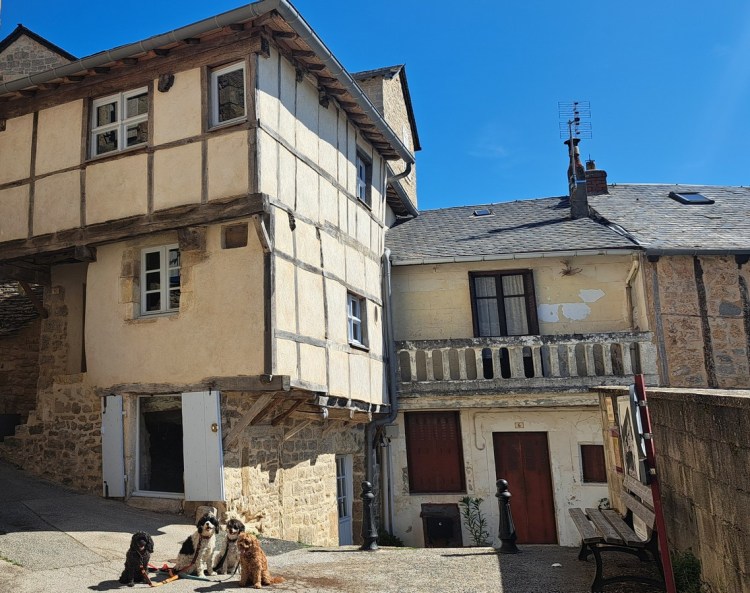
The name is more modern – Jeanne, an artist, was the last known occupant. She lived there until her death in the 1970s, after which the property stood vacant until the commune purchased it to restore in the 1990s.
There seemed to be no shops in the town, only the café from the night before, which was setting up for lunch. Denied a swift sandwich and eager to push on, we retreated to the truck and shared the flan we’d grabbed in Mende. What could make a finer or more balanced midday meal than half a six-inch (15 cm) French custard tart?!
On the way back down the lane, flanked by musty moss-covered stone walls, I had stopped to photograph a few of the local Aubrac cows. They have the gentle expression of Jersey cows – but slightly darker colouring, and they seem to have gone to town with striking black eye makeup. I mentioned that I’m partial to a castle, but add in a coo and I’m smitten. I captured castles and cattle: ramparts and ruminants, all in one single glorious frame!
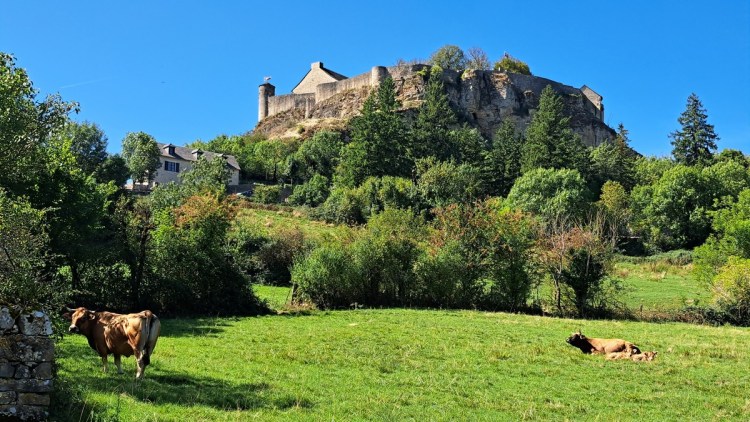
The Aubrac is an ancient breed, prized for both dairy and beef, but was almost lost with the introduction of more productive livestock strains. Like many rare breeds, they survived thanks to the efforts of determined enthusiasts back in the 1970s. Their milk produces some of the region’s wonderful local cheeses – proving that heritage really can pay delicious dividends.
Sévérac was the perfect bridge into Languedoc and Cathar Country. Not a bastide, not a showpiece, but a place that shows how settlements evolved, influenced by the landscape, power games, and the rhythms of daily life.
Our next destination, Cordes-sur-Ciel – planned carefully from the ground up as the first bastide – promised a very different medieval experience.
Did You Miss?
Below is the link to the first post in my Cathar Country series about the Languedoc in Southern France.
Languedoc, France: The Land That Says Yes! With Wind, Wine, & Rebellion
Wrapped around the Mediterranean coast, from Provence to the Pyrenees, lies the French region of Languedoc. Translated literally, the Languedoc – le langue d’oc – means ‘the language of yes’. In the southern French Occitan language, Oc was the word for ‘yes’, distinguishing it from…
Bargain Book!

Find all my other travel books via the links below:
Enjoy Reading?
Image – Yhe Beast at our park up beneath the castle at Sévérac-le-Château
 World Wide Walkies
A very interesting travel post and history lesson. I’ve read about the Cathars and the wars and persecution. A friend of mine who walked the Camino de Santiago / Campostela path with his family and wrote a book about it (they started in France) externsively described the history of the Cathars in his book.
LikeLiked by 1 person
Oh wow, Thomas, your friend’s book sounds fascinating – what is it called? I’ve only just discovered the Cathars from touring this region but the history, and it’s connection to England, is fascinating. We walked the dogs on part of the Santiago in France yesterday, and the French farmhouse we rented was right on it too.
Thank you so much for your kind words and I’m pleased you enjoyed the post!
LikeLiked by 1 person
Oh the book is “Onward, Backward! -or- A Ramble to Santiago” by Bennett Voyles. Thank you Jacqueline. Your post was certainly very interesting and informative.
LikeLiked by 1 person
Thanks Thomas – I shall check out Onward Backward’. I am addicted to travel writing and it sounds like this will resonate particularly since we’re in the region at the moment!
Thank you 🙂
LikeLike
Sévérac-le-Château’s historical buildings and quaint streets show a wonderful glimpse into its past. Thanks for the tour, Jaqueline! 🙂
LikeLiked by 1 person
It was a lovely little town!
Glad you enjoyed the tour. Thanks for reading and commenting, Nancy 🙂
LikeLiked by 1 person
Gosh, that was an interesting post. Now with those gorgeous coos, throw in a couple of little brown bantam hens and I’m in!
LikeLiked by 1 person
Oooh, absolutely! Banam eggs – food of the gods! 🙂
LikeLiked by 1 person
What a loely place to explore, though I would definitely get lost.
LikeLiked by 1 person
It was a proper maze of little streets, but at least it was small 🙂
I love a medieval meander.
LikeLiked by 1 person
Cows and castles, what a great combination.
LikeLiked by 1 person
Especially when they’re such handsome cows.
Thanks for reading and commenting, Glenys. 🙂
LikeLiked by 1 person
Wow, thanks for sharing this magnificent tour with us Jackie. 💜
LikeLiked by 1 person
Thank you for joining me, Debby! I’m so pleased you enjoyed it 🙂
LikeLiked by 1 person
What’s not to love? 🙂 x
LikeLike
Thanks for the awesome pictures and history lesson. I love the fab four in front of the castle entrance.
LikeLiked by 1 person
My absolute pleasure, Darlene. I am so pleased you enjoyed it – and The Fab Four are rather photogenic, aren’t they?! 🙂
LikeLiked by 1 person