
Apollonia, in southern Albania, is where Octavian received news of his great uncle, Julius Caesar’s murder. A student at Europe’s first university, Apollonia’s School of Philosophy, Octavian left immediately for Rome.
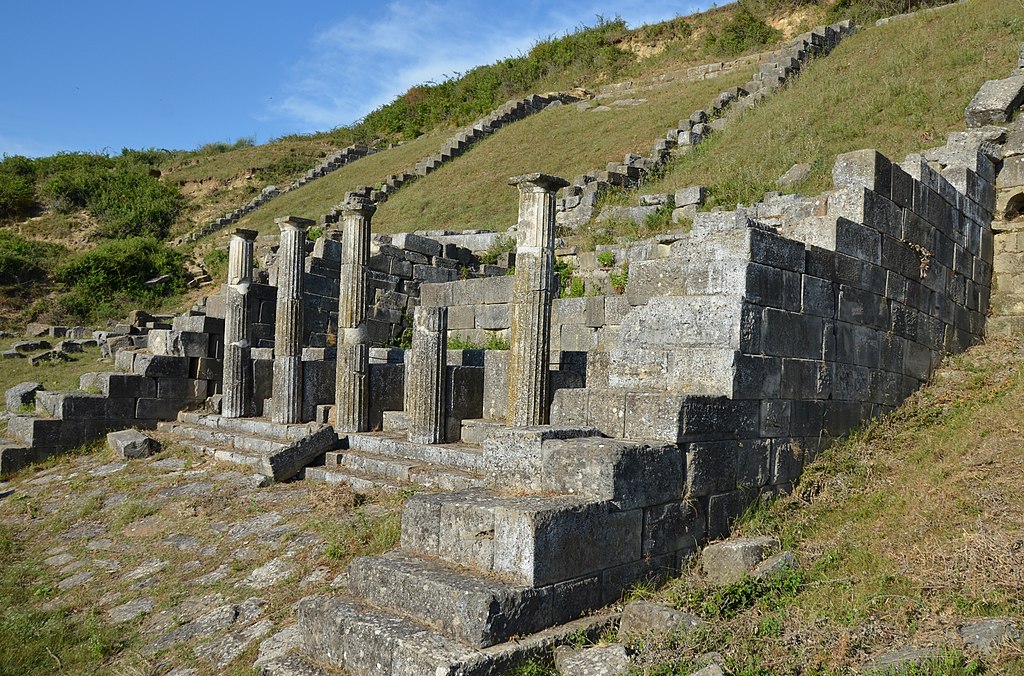
Image by Carole Raddato from Frankfurt, Germany, CC BY 2.0 https://creativecommons.org/licenses/by/2.0, via Wikimedia Commons
As Caesar’s adopted son and heir, Octavian went on to found the Roman Empire, became Rome’s first Emperor, Caesar Augustus, and is lauded as one of human history’s greatest leaders.
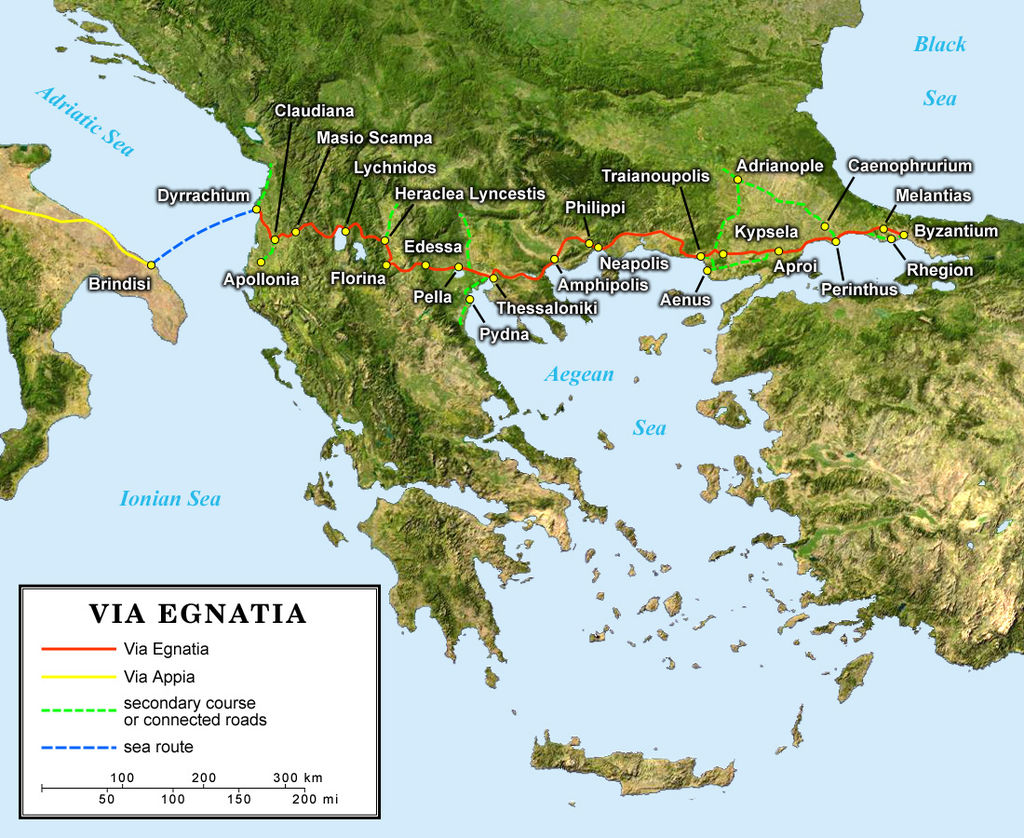
At the time, Apollonia was one of the most important city states in the Adriatic basin. In his Philippics, Roman philosopher Cicero referred to Apollonia as ‘magna urbs et gravis’ (a great and important city). Founded by the Illyrians in the 600 B.C., Apollonia came under Rome in 200 A.D. It was a major port, connected to the Aegean by the Vjosë (formerly Aoos) river. It was also located strategically on a prehistoric overland trade route, which later became the Via Egnatia: the principal connection between Rome and the east.
My friend, Gwyn, told me, “I visited Apollonia a couple of times 40 years ago, but it was on the other side of the Mediterranean and several hours’ drive from Benghazi.”
Indeed, there are almost thirty classical cities named after the god Apollo, but records show that Albania’s Apollonia was by far the most prominent.
At its peak, it was home to 60,000 citizens and minted its own currency. It was a hub for trade, culture, and learning. According to some sources, notable figures such as mathematician Euclid, philosopher Aristotle, and poet Archias taught at the city’s academy. Emperor Augustus’ fondness for Apollonia led him to exempt it from all taxes.
Despite all its historic grandeur and ‘tentative’ UNESCO listing, we had Apollonia in our sights because it was a convenient place to park overnight. Our injured pup Kai had a follow-up vet appointment at nearby Fier the following afternoon.
One trip-planning website claimed that from Livadh beach, we were ‘only a short drive away’ from Fier. It suggested we budget two-and-a-half hours for the 67 mile (108 km) journey.
However, Mark and I knew this ‘short drive’ involved the second half of the Llogar Pass: a star in the skies of the website ‘Dangerous Roads’. So, rather than trying to nip over to Fier on the morning of our appointment, we gave ourselves plenty of time to get there.
Thank goodness we did!
Once we set off, after my final morning dip in the glassy waters of the Aegean, the only way was up.
Mark pointed out our route, “That’s where we’re going. Into the clouds.”

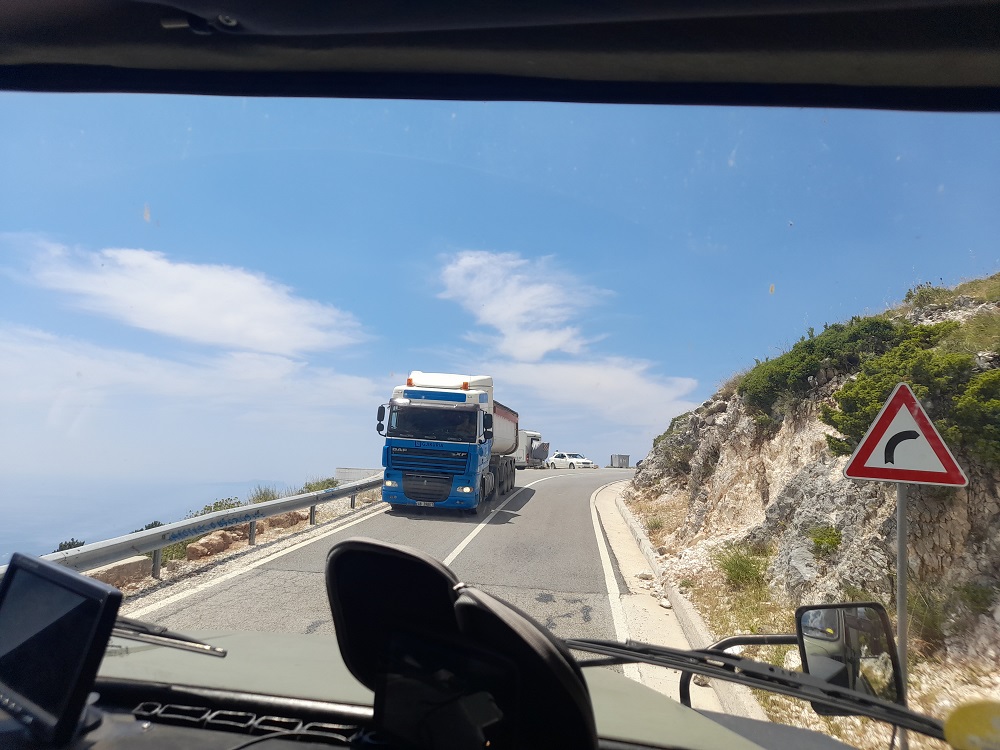
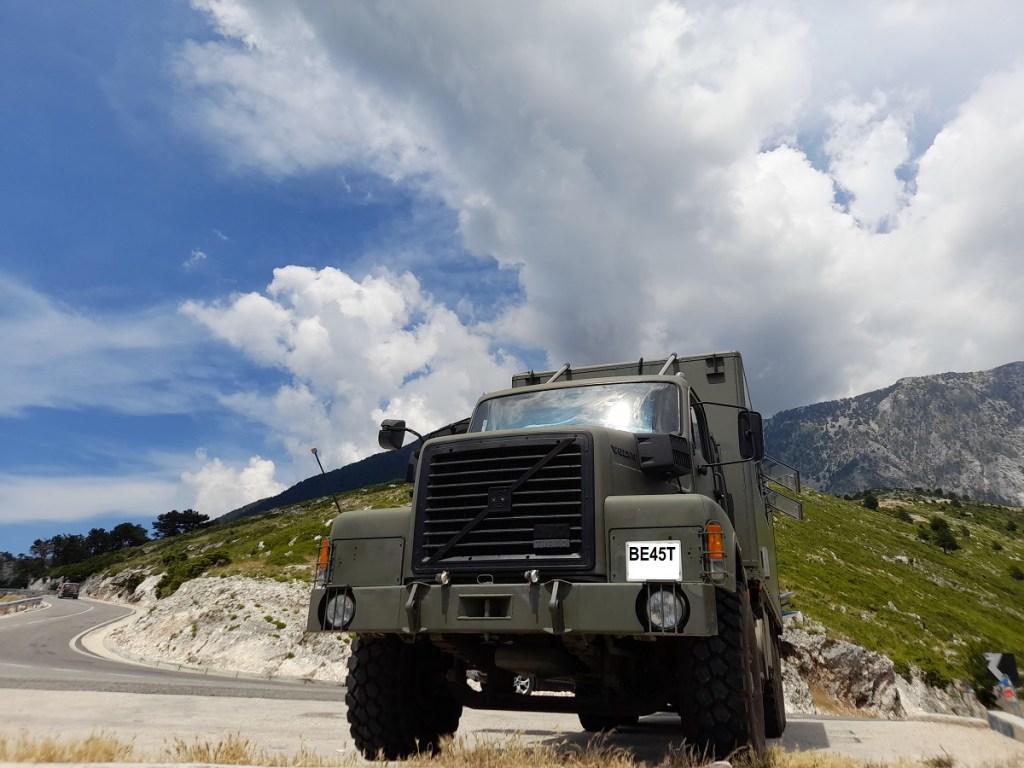
The Beast has a top speed of around 45 mph, but even we got stuck behind a slow-moving truck. At least it gave us a chance to admire the scenery – along with the signs that warned ‘Kudjes – Caution’, and ‘No Lorries’. Had I not seen so many articulated lorries coming the other way, the sign would have sparked churning anxiety, but clearly the road was fine – and no-one paid any attention to the notices.

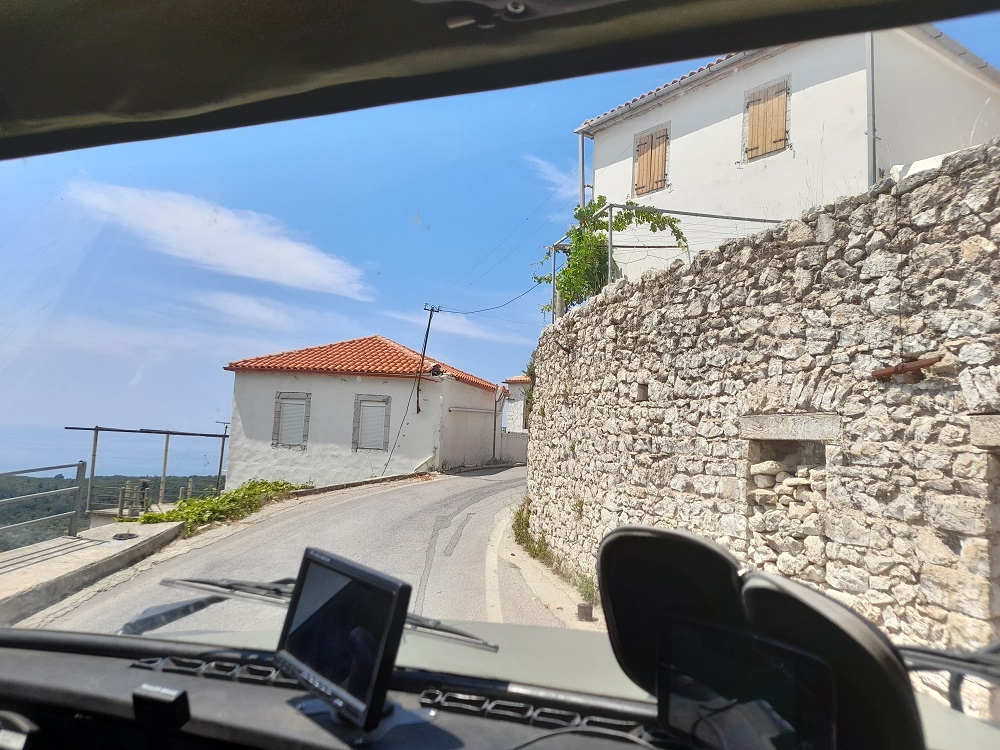
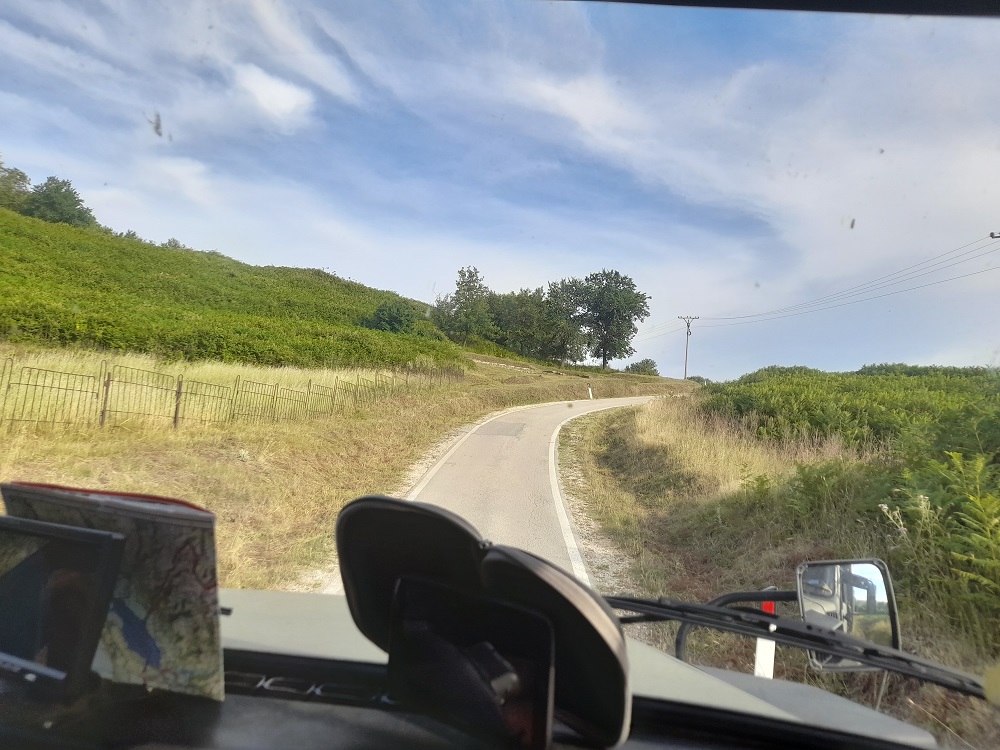
The carriageway was very narrow in places – so narrow that in Vuno, it was controlled by traffic lights. Yet the views of Albania’s gold and turquoise riviera got more sensational the higher we climbed. We made it around even the sharpest hairpins without having to reverse – even one near Dhërmi that came back on itself.


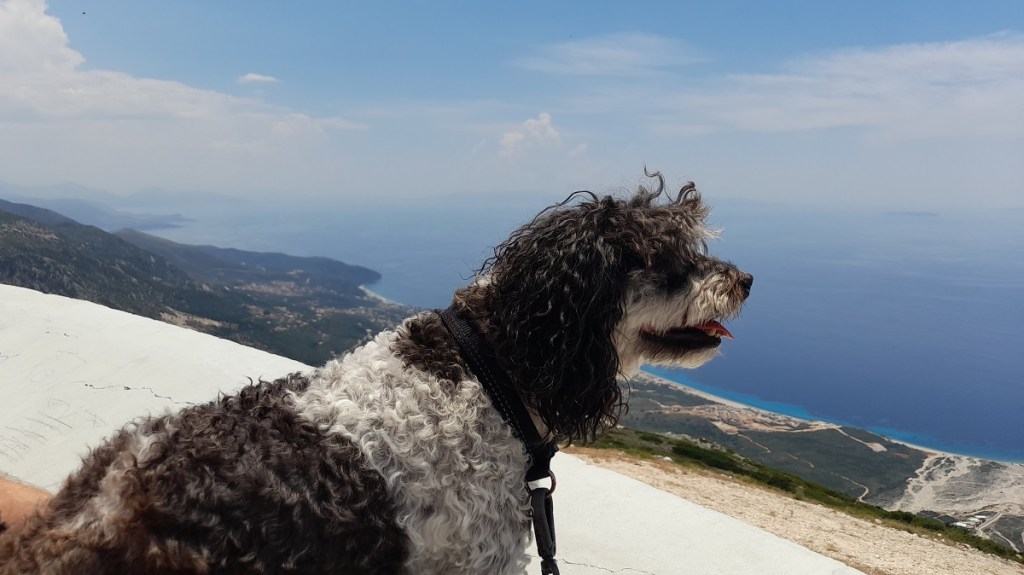
Just below the summit, we stopped for a cuppa at the panoramic viewpoint. The Fab Four clambered atop the broken remains of a bunker to admire the 1.5 km of sand that make up Palasë Beach. Julius Caesar sailed from Brindisi and landed there with his legions during the Roman Civil War in 48 B.C. He crossed the Llogar Pass to invade Macedonia in pursuit of his adversary, Pompey.
We chatted to a paraglider about to launch himself into the void and land around 3,000 ft below on what is still known as Caesar’s Beach. When we said we were visiting the vet in Fier, he told us he knew Dr. Andi, so we promised to pass on his regards.



Yet we still had not reached the top.
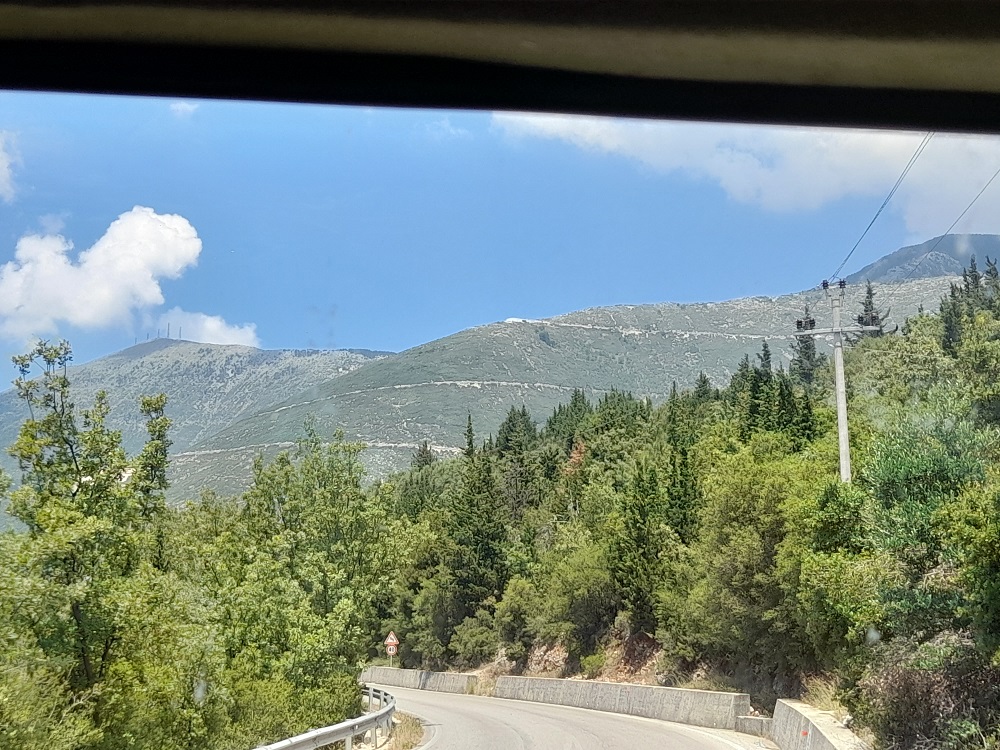
The thought of the descent from such dizzy heights sparked massive brake anxiety. Yet, even though I know it’s a physical impossibility, rather like our circumnavigation of Britain’s Isle of Wight by bicycle, I swear there was more up than down! Mark was right when he said we had ascended the steeper side.

The heavily forested Llogar National Park looked so appealing, not least for the promise of shady walks, but with a looming vet appointment, we were forced to pass it by. We stopped twice on the way down because our brakes were smoking. First, we pulled over in a layby which happened to be opposite a house with honey for sale on a table outside. As if by magic, the owner appeared with an expectant smile. Unable to explain we’d stopped to cool our brakes, we caved in. The size of his grin suggested we made his day when we bought a huge jar of home-produced amber deliciousness for €10. Thereafter, the road looked flat, although judging by how much speed we picked up, it was an optical illusion!
Our second stop was for coffee with the lovely chap who ran a cafe and petrol station just above Vlorë. We conversed via sign language, Albanian, plus the odd word of German and Italian. The coast and country views were lovely, so the hour-long stop was a genuine pleasure. I tried Mark’s iced coffee, which came in a can. While I remain open-minded to the concept, this, my third attempt at iced coffee, did not change my stance that coffee should be hot, and chilling it is the work of the devil.


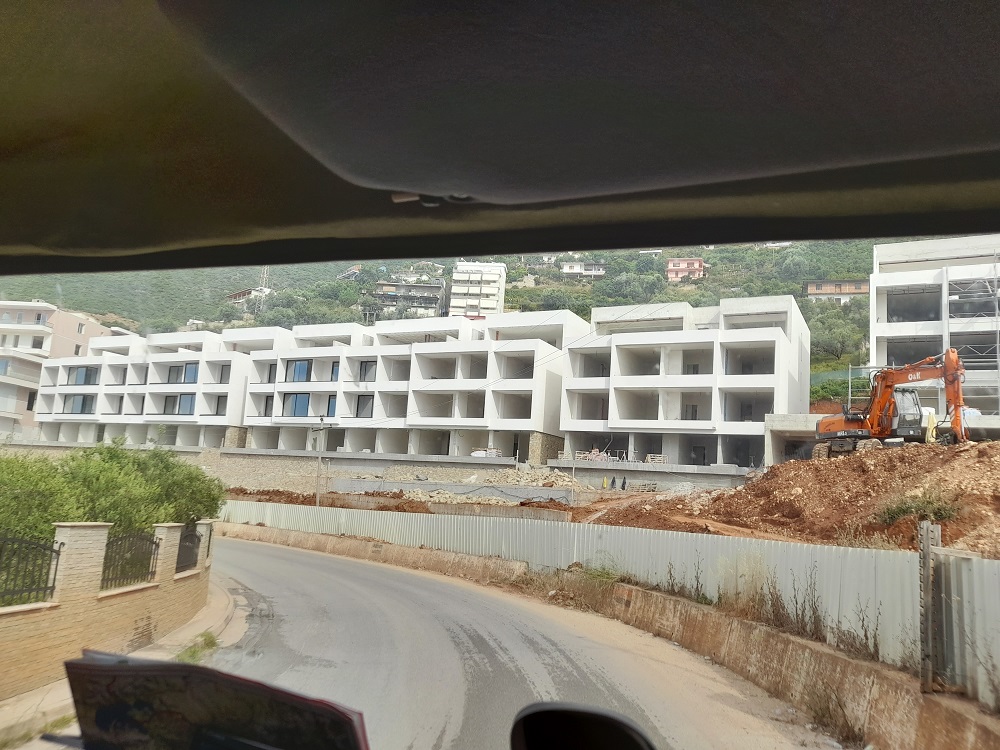
As we dropped into Vlorë, the relentless crush of progress was evident. If you want to see an unspoilt Albanian Riviera, I suggest you hurry, because development is coming fast. As we struggled to overtake a steam roller on a piece of brand-new road, we saw a tunnel under construction through the mountains to make the Riviera more accessible. All along the coastline, blocks of identical concrete apartments and hotels were being thrown up. The centre of Vlorë is already ruined. It looked like Tourist Central – or Hell on Earth by our standards. The broad boulevard was a single carriageway in either direction, separated by a raised central reservation, which one bright spark mounted and used to overtake us!

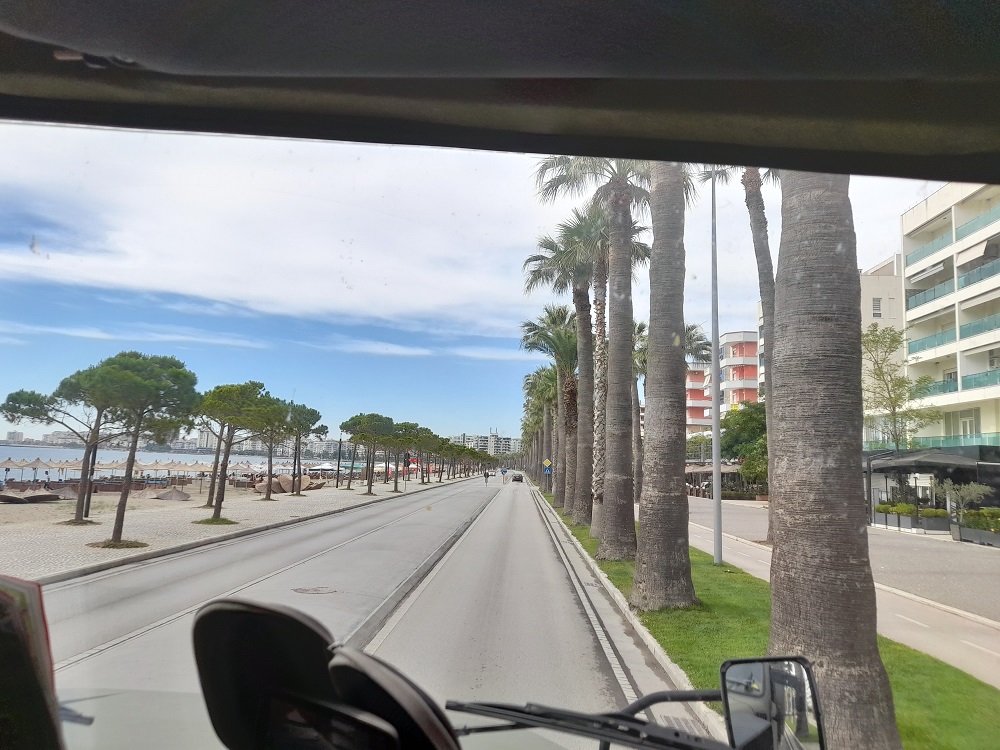
We were glad we left ourselves the whole day to get near Fier. Even budgeting for our dilatory approach to travel and The Beast’s unimpressive top speed, the journey was a much slower than even we anticipated. Our average speed across the Llogar Pass was ten miles per hour, not counting the two long stops to cool down our brakes!
Our tribulations were not quite over, though. We had to find the car park at Apollonia, which seemed to perplex Google Maps, our Park4Night app, and the satnav. Since we had no food, we were seeking a restaurant near the park up. We wound our way through all kinds of narrow lanes, villages, and over a very worrying bridge. The more we hesitated to assess the load-carrying capacity of the bridge, the more enthusiastically a local beckoned us to cross, but we were waiting for him to get out of our way so we could take a run at it. Our strategy with iffy bridges is: we’re lighter if we’re faster…


We found the park up in the end, but no restaurant. I improvised with a cupboard meal of orzo pasta with garlic, lardons, frozen peas, and parmesan cheese – a sort of risotto without rice, which is quick and delicious. Plus a beer. We really needed a beer. We shared it with our neighbours, Roxy and Charlie, a young British couple in a campervan filled with dog food to feed the strays. Several strays patrolled the car park. They were friendly enough, but since Kai was still suffering from a dog attack nearly a month before, we remained wary.

Park4Night intimated that a moonlight visit to the ruins was sometimes permitted, which would have been amazing. Unfortunately, the guard kept the gates firmly closed overnight.
Despite its importance and fabulous state of preservation, Apollonia is really not on the tourist map. The ancient city straddles two hilltops. One was the sacred area surrounding the temple of Apollo, the other the Arx, a military citadel, with the main public space in between. An area of 81 hectares was surrounded by a wall 2 miles long and nearly 10 ft wide, although at its peak, the city covered 130 hectares. Less than ten per cent of the area has been excavated.

Fortifications: A1 – acropolis, A2 – temenos wall, A3 – eastern gate, A4 – eastern bastion, A5 – southern gate
Greek Age: B1 – nymphaeum, B2 – theather, B3 – Artemis (Apollo) sanctuary, B4 – great stoa, B5 – Apollo column & altar stones, B6 – small stoa, B7 – gymnasium, B8 – sanctuary in Shtyllas
Roman Age: C1 – odeon, C2 – library, C3 – bouleterion, prytaneion & Dionysos sanctuary, C4 & C5 – peristyle house, C6 – bath/thermae)
Modern Additions: D1 – St. Mary Monastery & Archaeological Museum of Apollonia, D2 – restaurant, D3 – cemetery
Brown lines = old streets, Grey lines = current unpaved roads
Map of Apollonia by Pasztilla aka Attila Terbócs, CC BY-SA 4.0 https://creativecommons.org/licenses/by-sa/4.0, via Wikimedia Commons
Peaceful pasture and olive groves surround the archaeological site. Nature is very much part of its proposed UNESCO listing. In addition to its historical credentials, which span Bronze Age, Illyrian, Greek, Roman, and Medieval civilisations, the ruins provide a sanctuary to the globally threatened Hermann’s tortoise.

Our tour of Apollonia was largely governed by the need to find shade.

Near the entrance, the Monumental Centre containing the Bouleuterion, or monument of Agonothetes, was hard to miss. The classical Greek façade, supported by six Doric columns, looked like a smaller version of the Parthenon in Athens. It is the symbol of Apollonia, and although it looks like a temple, it actually housed the city state’s council of citizens, or boule. The gathering area to the rear could accommodate 160 people, and is unusual, because it is horseshoe-shaped rather than a semicircle.

Built into the hillside directly opposite was the Odeon, terminology which relates to a small covered theatre. Its stepped seats remain, and show it had a capacity of around 650 spectators. It would have hosted meetings and lectures as well as theatrical performances.

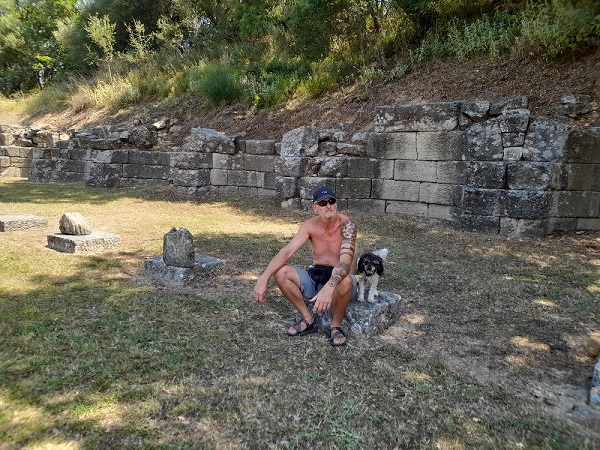
We wandered up the remains of the Great Stoa, which would have been a two-storey covered walkway, originally supported by two sets of octagonal marble Doric columns. It dates from the 3rd century A.D. Almost 250 ft long, its rear elevation acted as a retaining wall to prevent the hillside collapsing, and contained 17 niches to house marble statues. The upper storey would have been level with the Agora. Literally ‘the gathering place’ in ancient Greek, the Agora is where business and social activities took place, and is the root of the word agoraphobia.
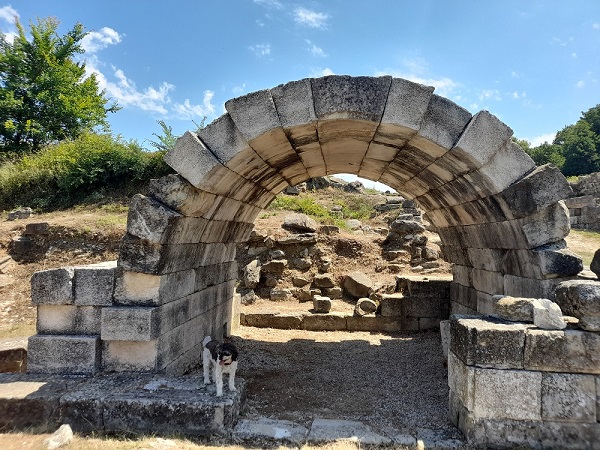
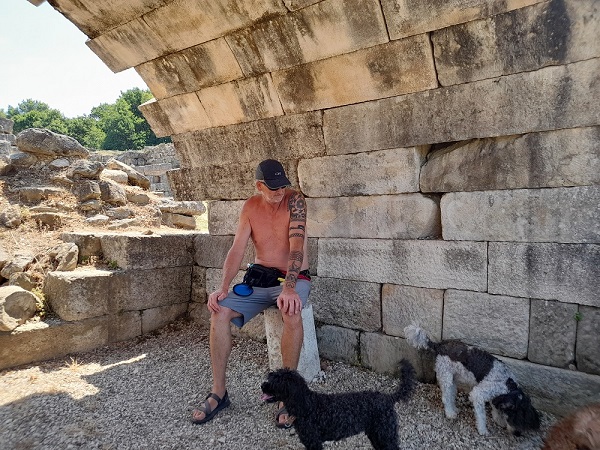
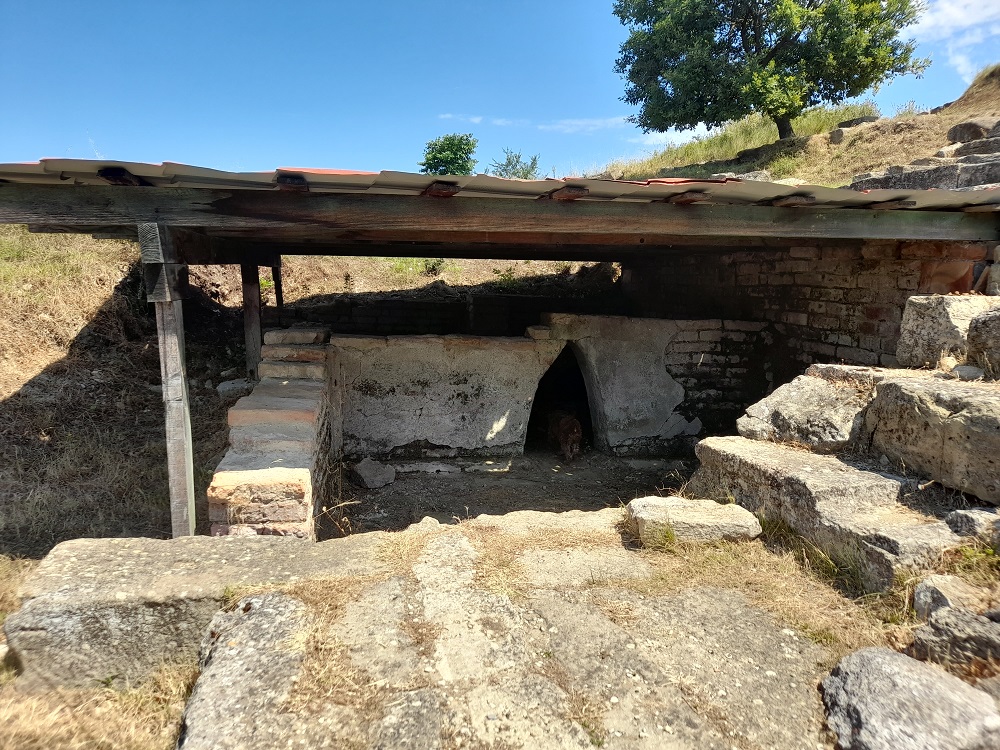
Past the Stoa, we reached an section containing storehouses and cisterns, which provided welcome respite from the searing sun. We made a dash towards the hilltop Temple of Apollo, although there was little to see. Mark and the pups hid in the shade of a tree between the two hills while I explored the Arx. All I found were concrete bunkers from the Hoxha era.

When I returned, Charlie, Roxy, and a Frenchman had joined Mark under the tree. Since The Fab Four had drunk all our water within ten minutes of entering the site, we decided to repair to the restaurant Leon Rey, named for the French archaeologist who uncovered many of Apollonia’s most significant ruins.


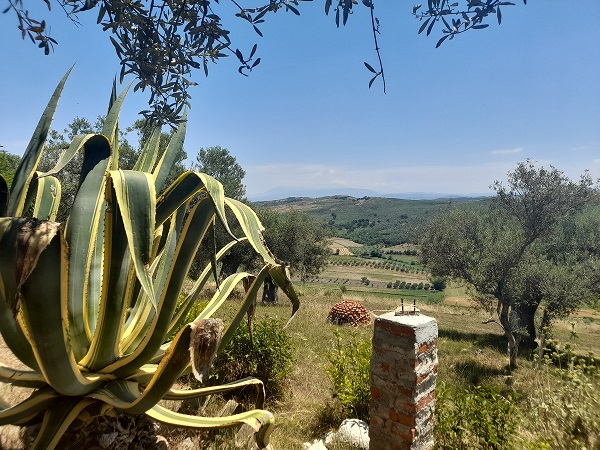
The restaurant was wonderfully shady and had the most amazing views over Apollonia and the surrounding area. The plain which separates Apollonia from the sea gives a clue to the city’s demise. It was once a lagoon, which gradually silted up. Then, a huge earthquake in the 4th century changed the landscape and diverted the course of the river. Malarial swamps crept closer to the city, which eventually became uninhabitable.

Navigation was difficult, since maps of the site are notoriously hard to come by and we were basically following our noses. (I hope you appreciate the extensive research it took to find the Hungarian map!)
The site is vast, and it was too hot to continue exploring the other monuments, such as the Nymphaeum – not that we had the slightest clue where it was. The museum, Byzantine monastery and church, built in the middle ages from stone looted from the ruins, were close to the entrance, but we had to leave for our vet appointment.
Back in Fier, as we waited for Dr. Andi, we met two Albanian police officers from Berat. Mira and Edi came inside The Beast to have a look. Their son’s poor little pup had also been given Ivermectin (the wrong medicine that was administered to Kai) and had needed emergency treatment. They were absolutely lovely, and we agreed to meet up with them back in Berat.
We also met a Dutch couple with a very sweet street dog they had rescued. Yllka looked like a very undernourished black and blue marl Springer Spaniel. The poor girl had a badly broken leg and was suffering from Leishmaniasis. She would need medication for the rest of her life – if they could even get her back home to the Netherlands. The rabies blood titre test required to enter the E.U. is not available in Albania. They had an uphill struggle in front of them.
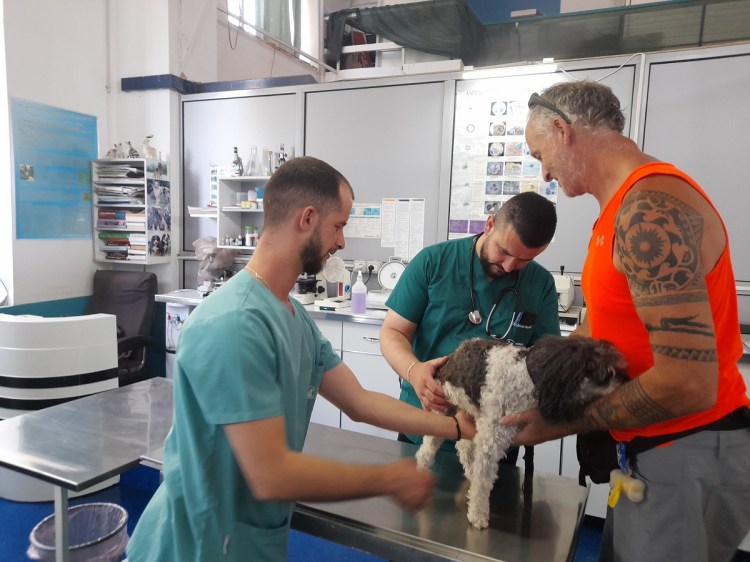
Kai needed stitches to close one of his more stubborn wounds, but was otherwise given a clean bill of health. Dr. Andi, An Ni, and Dr. Luiza insisted on taking us out once they finished work. Over coffee, Dr. Luiza said,
“I studied in Italy. I was the first small animal vet in Albania!”
She told us all about the work they do.
“We have 25 rescue dogs. They are all disabled, so they get the care and treatment they need for free. They are family!” she told us.
When Mark offered to pay for everyone’s coffee, we got a lesson in Albanian hospitality.
“We invited you out. You don’t pay!”
Mark’s well-meaning gesture would have been very offensive had we not been among friends.
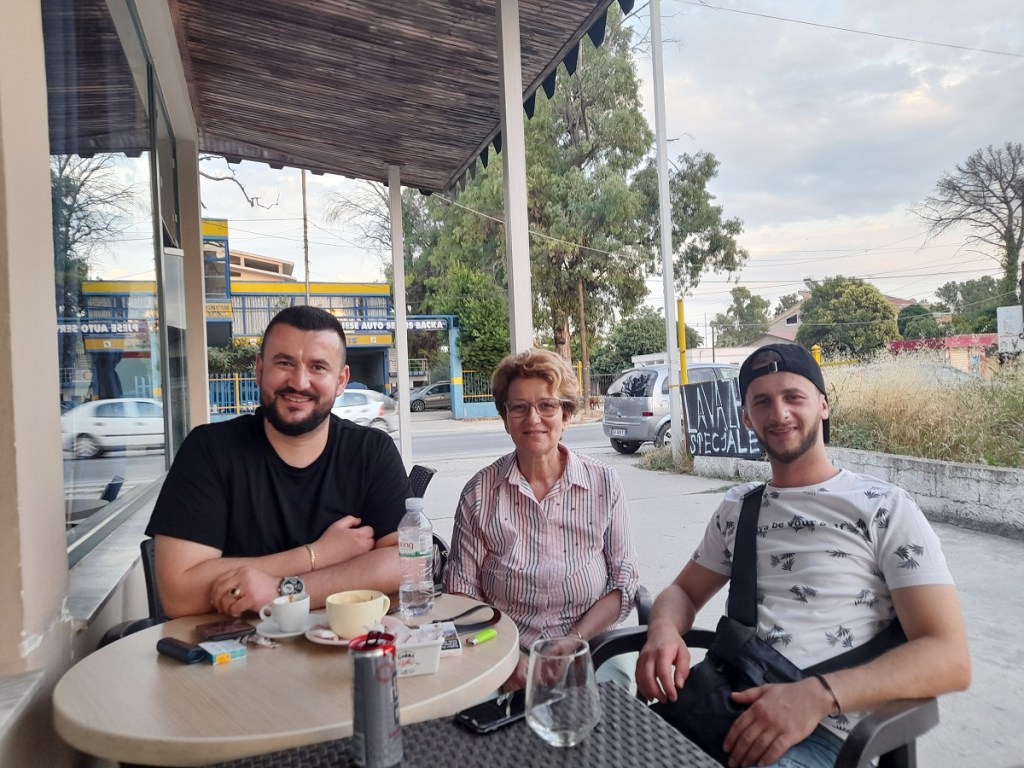
The Dutch couple had suggested a park up on the northern shore of the Nartë lagoon, near the pink salt flats we’d driven past a few times, just north of Vlorë. (We’d seen St. Mary’s monastery on an island at the southern end of the lagoon when we’d driven to Dalan Beach.)
“It was beautiful,” they told us. “There are sand dunes, and we saw pelicans and flamingos – although I’m not sure you’d get your truck in…”
It was late when we left Fier, so we spent the night on familiar territory – back at the restaurant by the lake, with its frogs, tortoises, and well-meaning comedy waiter. We explored the menu once again, with its tempting offerings of Turkey Cock, Goose In (Sac), and Pasta With S. Sea Fruits.
It was a nice way to be discharged. Our travels will now no longer be dictated by Kai’s vet visits, but we made firm friends in Fier – and gained a reason to return to Berat.
Join us next time as we go in search of Albania’s national hero!
Support Animal Welfare in Albania
If you would like to give much-needed support to animal welfare in Albania, you can make a donation directly to the Animal Veterinar Hospital in Fier. The vets give their expertise for free, but need money for food and medicine. By giving direct, we know that the money is used solely for the benefit of the 4 Paws.
You can make a donation via Paypal on animalhospitalveterinary@gmail.com. Any amount would be much appreciated! If you do not have Paypal, you can donate direct by bank transfer. The details are given below:

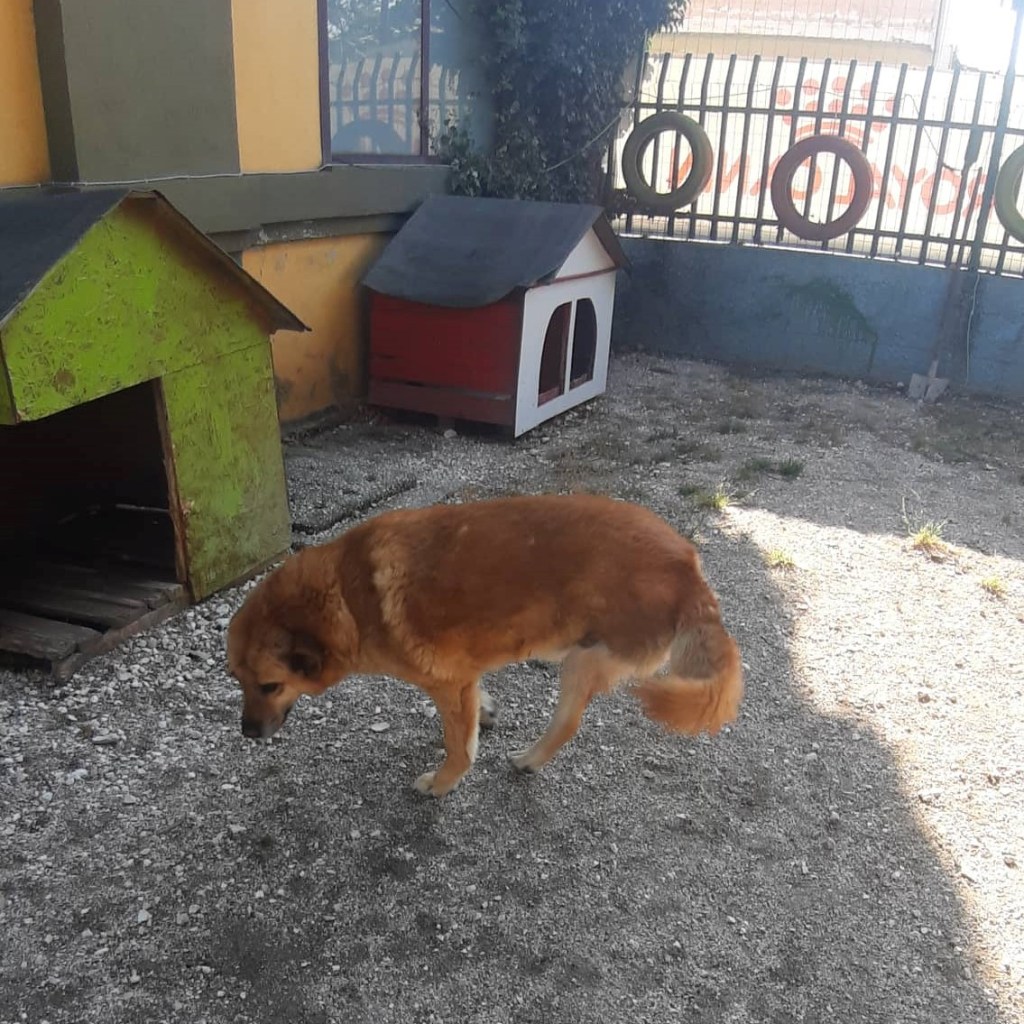
Meet Some of Animal Veterinar Hospital’s Permanent Residents


For more details and to see other ways to help, see my post Animal Charities & Volunteering in Albania

 World Wide Walkies
Such a great story Jacqueline and loved the photo of The Fab Four on the rock. You’re having some amazing adventures
Thanks for the history lesson ☺️
LikeLiked by 1 person
You’re welcome! I had no idea that Caesar himself trod the same path or that Emperor Augustus woz ‘ere. I love things like that.
LikeLiked by 1 person
It’s terrible what happened to Kai but I am so glad he is doing well. That Dutch couple are really doing nice taking care of that dog. I hope they will be able to bring her back with them.
LikeLiked by 1 person
They were absolute sweeties, and Yllka definitely fell on all four paws. I’m sure they will find a way. It’s not impossible, just difficult.
LikeLiked by 1 person
So many many beautiful photos, thank you for sharing! Also, for helping continue my history education, which is woefully lacking. And totally with you on iced coffee, work of the devil. Like a mocha! Sacrilege to ruin a perfectly good coffee that way!
LikeLike
I had no idea that Albania had such a long and prestigious history. Too bad the historical site isn’t better signed or mapped. Maggie
LikeLiked by 1 person
I was surprised on both counts too!
Everything you read about Apollonia says that the signs are hopeless and I couldn’t believe how hard it was to find a map, even delving into academic papers!
Thanks for reading and commenting, Maggie! xx
LikeLiked by 1 person